

The most common reason staff augmentation underdelivers is not the quality of the engineers. It is the quality of the integration. According to Softura’s enterprise augmentation research, when done right, augmented teams reduce project turnaround by 30–40%, improve software quality metrics, and minimize rework cycles. When done poorly, the same engineers become a coordination overhead that slows your existing team down. The difference is management how you integrate, direct, and measure augmented engineers from day one.
Why Augmented Engineer Management Is Different
Augmented engineers are not employees. They are not independent contractors either. They occupy a specific position: technical contributors working under your direction, employed by the staff augmentation provider, integrated into your team’s processes. That position changes the management dynamic in three specific ways.
First, the performance management channel is different. Underperformance does not go to HR it goes to your account manager at the provider. Your technical lead manages daily direction and quality; the provider handles employment, payroll, and if necessary, replacement. Knowing which lever to pull and when prevents the most common management mistake: treating an augmented engineer like a full-time employee in the wrong contexts.
Second, the integration depth determines the output quality. An augmented engineer who is added to a separate channel, given a separate review track, and excluded from retrospectives is not part of your team
they are a subcontractor with a Slack account. Engineers treated as team members produce team-member quality work. The evidence is consistent across providers: according to Hatch Works’ 2026 staff augmentation guide, the teams that get the most value from augmentation treat external engineers exactly like internal engineers in all workflow respects.
Third, institutional knowledge is a liability if not managed. Every augmented engineer who works in your codebase without documentation requirements is accumulating knowledge that leaves when the engagement ends. This is the hidden cost of augmentation that compounds silently: the re-onboarding tax paid every time a new engineer has to reconstruct decisions the previous one made.
The Pre-Day-One Checklist: What Has to Happen Before the First Standup
The most reliable predictor of augmented engineer performance in the first 30 days is what happened before day one. According to Genetech Solutions’ 2026 onboarding research, the companies that achieve productive output within 7–14 days share a common pattern: access is provisioned before the engineer’s first day, not during it.
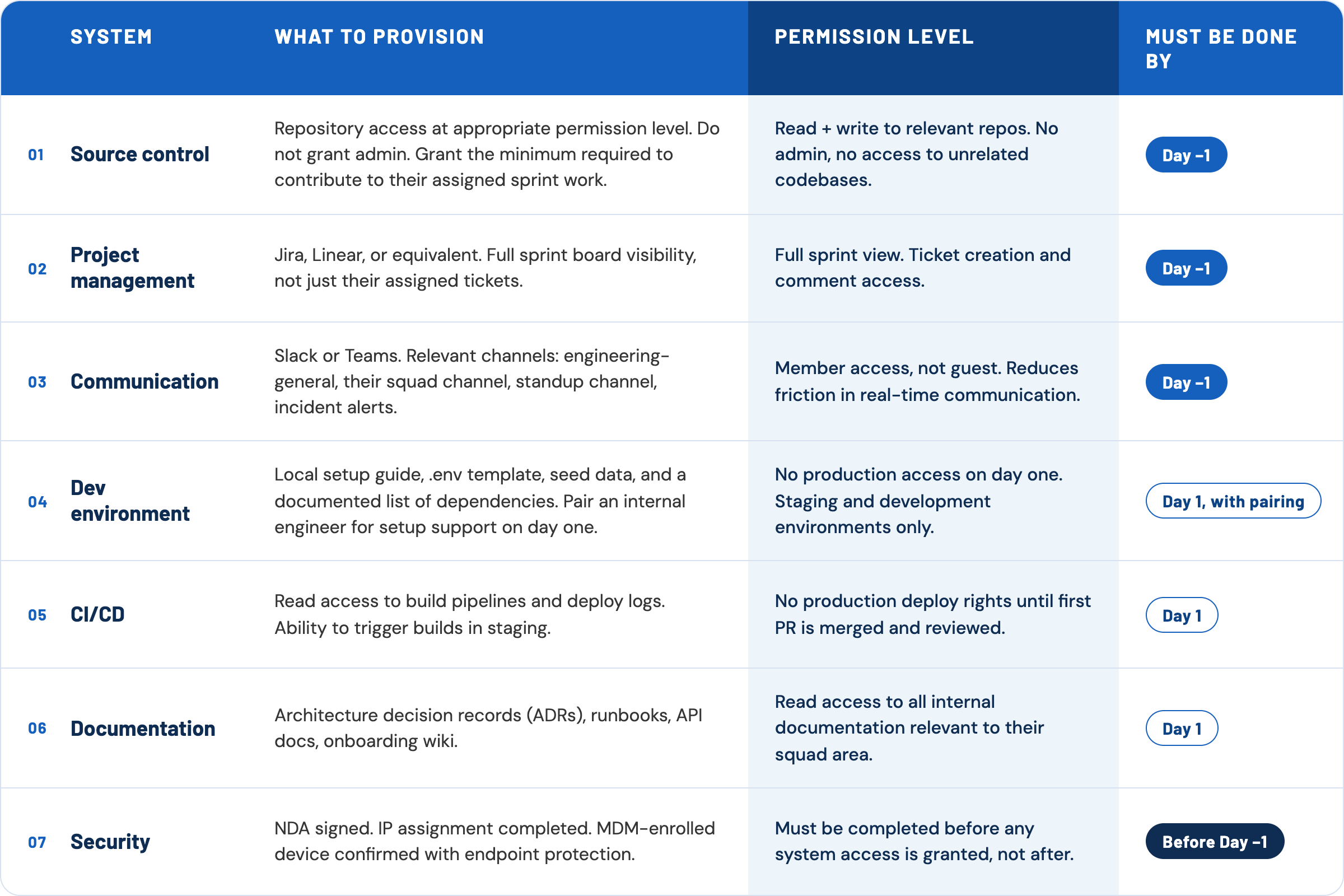
The NDA and IP assignment are not paperwork formalities they are access preconditions. Every augmented engineer who touches your codebase without a signed IP agreement is a legal exposure. Bluelight completes all NDA and IP documentation before an engineer’s first day as a standard engagement requirement, not an optional add-on.
The First Sprint: What Good Integration Looks Like in Practice
The first sprint is the most critical 2-week window in any augmentation engagement. The decisions made in that window which ticket to assign, who to pair with, how to handle the first code review — determine whether the engineer is on an acceleration trajectory or a prolonged ramp.
The First Ticket
The first ticket should be real, bounded, and completable within 3–5 days. Not a tutorial. Not a bug hunt in an unfamiliar system. A genuine feature or improvement that requires reading existing code, making a decision, and shipping something that can be reviewed.
The diagnostic value of a first ticket is underused. A well-chosen first ticket reveals in 5 days what no interview process can: how the engineer reads an unfamiliar codebase, how they ask for help, how they document their changes, and how they respond to code review feedback. That signal is more reliable than any pre-hire assessment.
The Pairing Partner
Assign a senior internal engineer as a pairing partner for the first sprint. The scope is specific: one 30-minute pair session per day in week one, reducing to on-demand in week two. The goal is context transfer, not supervision. The pairing partner’s job is to answer the questions that are not in any documentation: why the architecture was designed that way, which parts of the codebase are in active refactor, which technical debt decisions are intentional.
According to Softura’s augmented team governance research, organizations that use a buddy system during onboarding see measurably faster time-to-productivity. The mechanism is specific: psychological safety. An engineer who can ask ‘why does this service do X’ without judgment produces better code faster than one who reads the code in silence and guesses.
The Communication Norm Conversation
Have an explicit conversation about communication norms in the first week. Do not assume a LATAM engineer working US hours knows your team’s unstated expectations about response times, Slack etiquette, or when to escalate versus figure it out independently. The norms that are obvious to your existing team are invisible to someone new.
The three norms that cause the most friction if left unstated:
- Blockers: when to raise them and through which channel. A junior engineer who sits on a blocker for 4 hours before posting in Slack has cost the sprint more than the blocker itself.
- Response time: what is expected for async messages during working hours. ‘Respond within 2 hours’ is a specific norm. ‘Be responsive’ is not.
- Code review: how quickly to expect reviews, how to interpret review comments (blocking vs. suggestions), and the norms around PR size and frequency.
Day-to-Day Management: Sprint Integration That Actually Works
Once past the first sprint, the management model should be minimal additional process. Augmented engineers integrated into your existing sprint ceremonies do not require a separate management track — they require the same structure as your full-time engineers, nothing more.
Sprint Ceremonies
Augmented engineers attend all sprint ceremonies: planning, standup, demo, and retrospective. No exceptions, no separate standup. A CTO who runs a separate standup for augmented engineers has signaled to both groups that they are operating in different teams, which becomes a self-fulfilling architecture over time.
Code Review
Augmented engineers submit PRs through the same process as full-time engineers. Their code gets reviewed by the same people, to the same standard. A separate review track for augmented engineers produces separate quality outcomes. If your engineering lead does not have bandwidth to review an additional PR per sprint, the capacity constraint is in your engineering lead, not in the augmented engineer.
The 30-Day Check-In
A structured 30-day check-in between the engineering lead and the augmented engineer is one of the highest-leverage management actions in the first engagement. Cover three questions: what is going well, what context is still missing, and what the next 60 days should focus on. This is not a performance review it is a course correction opportunity before small friction points become engagement-ending problems.
The most common thing discovered at 30-day check-ins: the engineer has been operating around a process confusion or access gap for two weeks and did not know it was worth escalating. A structured check-in creates the permission to surface it.
Performance Management Without HR Processes
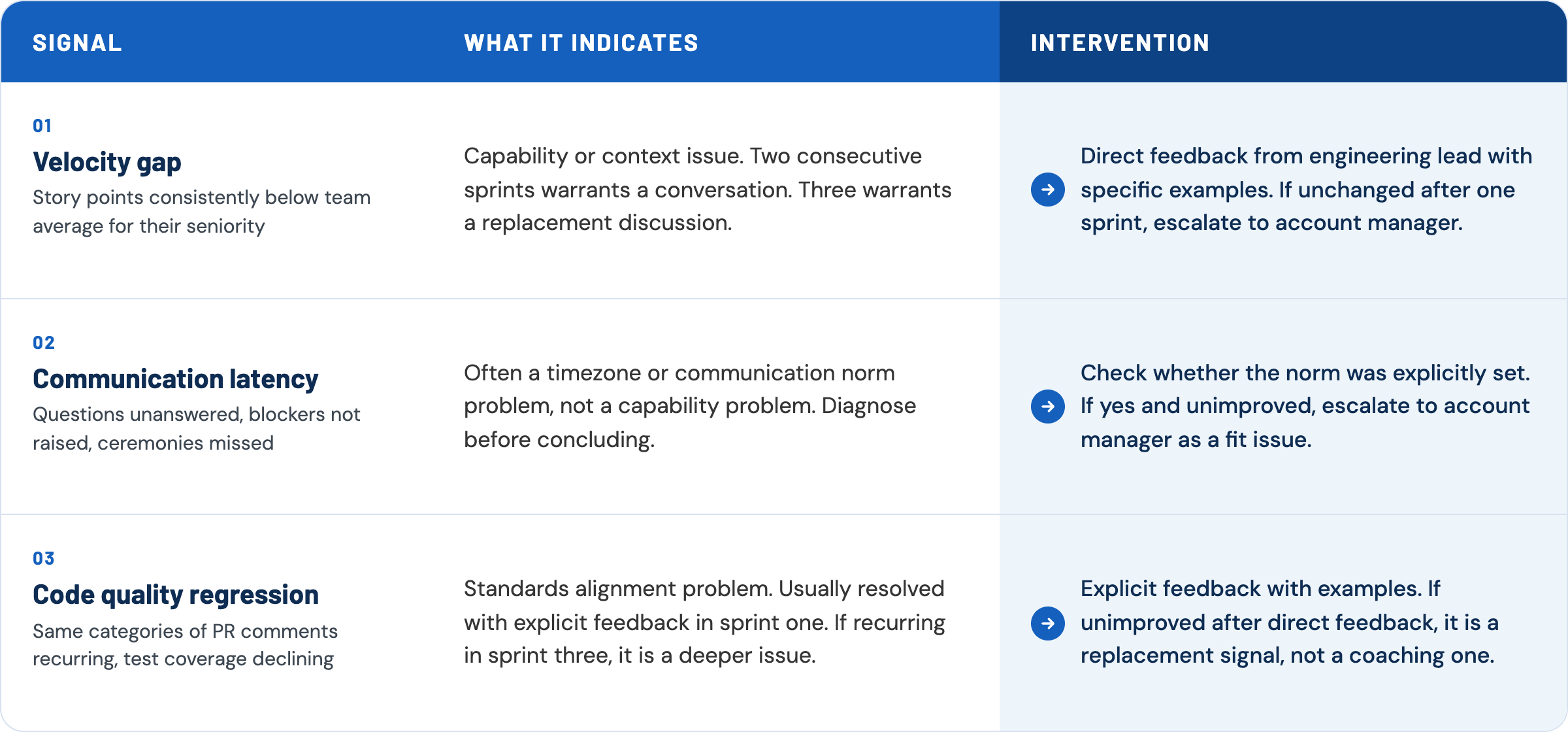
Performance management of augmented engineers runs through engineering channels, not HR. If an engineer is underperforming, the intervention sequence is: direct feedback from the engineering lead, escalation to your account manager at the provider, and if unresolved, a replacement request. The provider handles HR consequences; your engineering lead handles technical direction.
The Three Performance Signals to Track
According to KORE1’s 2026 staff augmentation best practices, the ratio of augmented engineers to full-time engineers should stay at approximately 1:2 for most teams. Above that ratio, review capacity becomes a bottleneck and integration quality drops as your senior engineers spend more time managing than building. Below it, the cost-benefit typically holds.
The Replacement Decision
Replacing an augmented engineer mid-engagement costs 2–3 weeks of velocity: the outgoing engineer’s final sprint, the incoming engineer’s onboarding dip, and the knowledge transfer between them. It is always more expensive than it looks. That does not mean keeping underperforming engineers is right it means making the decision deliberately, not reactively.
Replace when: three consecutive sprints of underperformance against clearly communicated expectations, or a code quality or security incident that demonstrates a fundamental gap, not a learning opportunity.
Coach and retain when: the engineer is technically capable but still building context, performance improved after specific feedback was given, or the issue is a communication style mismatch rather than a capability gap.
Bluelight’s model includes a 2-week risk-free trial on every engagement. If the engineer is not the right fit in the first two weeks, Bluelight replaces them at no cost and restarts the onboarding clock. This is not a courtesy it is the single most important contractual protection in any augmentation agreement because it concentrates the most common mismatch risk at the lowest-cost moment.
IP, Security, and Legal Protection: Non-Negotiables
Augmented engineers access your codebase, staging environments, and often your production infrastructure. The security model cannot be an afterthought.
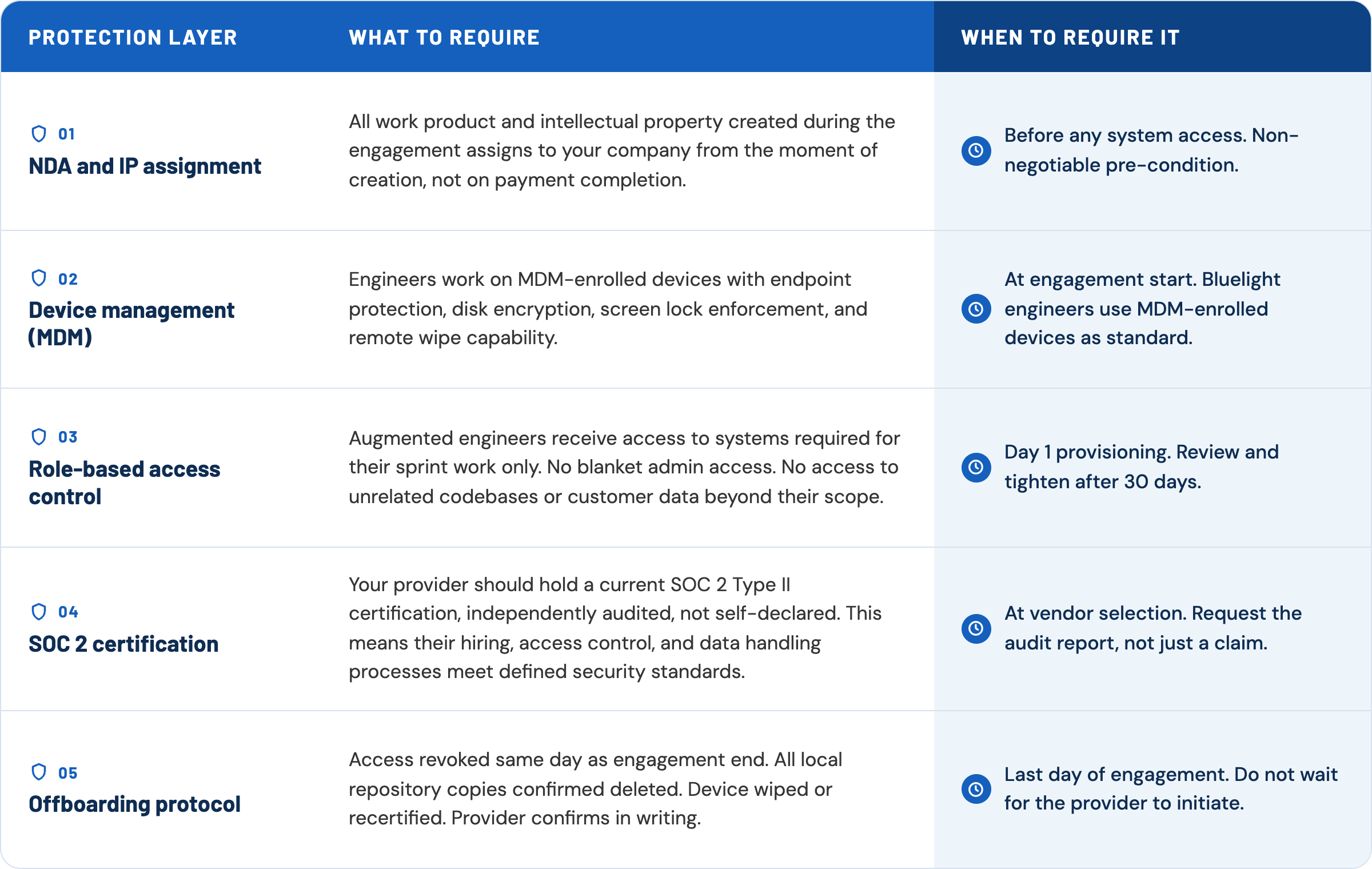
Bluelight holds SOC 2 certification. Every engineer signs NDA and IP agreements before engagement start, works on MDM-enrolled devices, and is offboarded through a documented security checklist. For regulated industries (healthcare, fintech, government), Bluelight’s compliance posture also supports HIPAA and PCI-DSS requirements. See Bluelight’s security practices →
Knowledge Transfer: The Engagement Lifecycle No One Plans For
Augmentation engagements end. The question is not whether institutional knowledge will leave it will but whether you planned for it. Teams that do not plan for knowledge transfer pay the re-onboarding tax on every subsequent engagement in the same codebase area.
Three practices that reduce knowledge loss:
- Architecture decision records (ADRs): require augmented engineers to document non-obvious technical decisions in a standard format as part of their definition of done. Not in their heads, not in a PR comment that gets closed in a permanent, searchable record.
- End-of-sprint documentation reviews: a 15-minute review at the end of each sprint where the engineering lead confirms that any new system behavior, integration, or architectural pattern the augmented engineer introduced is documented in the appropriate place.
- Structured offboarding sprint: plan the final sprint of every augmentation engagement as a knowledge transfer sprint. The engineer produces documentation, conducts walkthroughs, and reviews critical systems with the internal engineer who will own that area going forward. This is not optional if you plan to scale the same codebase area later.
Metrics That Tell You Whether the Engagement Is Working
Headcount added is not a performance metric. These are the measurements that tell you whether an augmented engagement is delivering value or overhead.
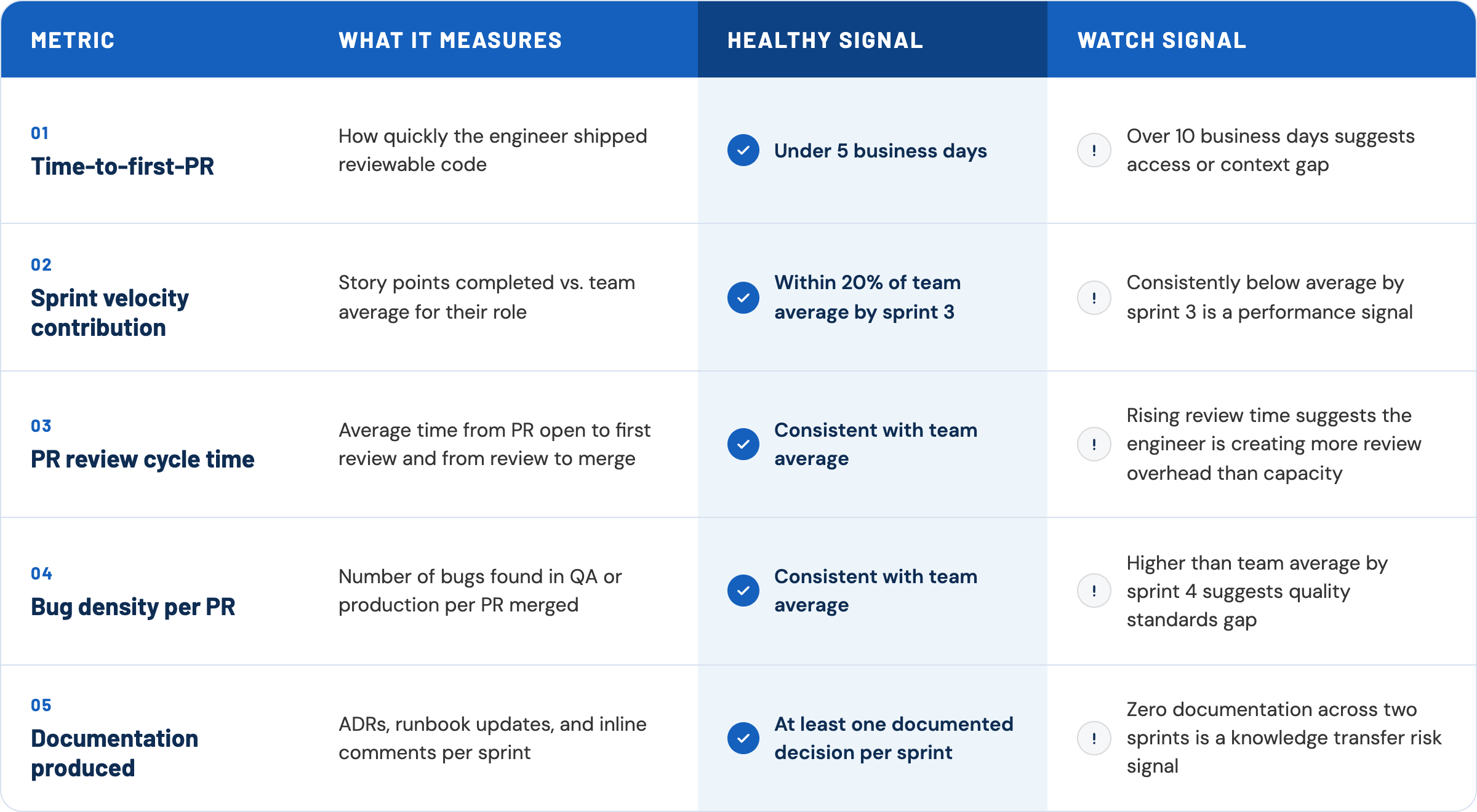
This is the framework Bluelight's account managers use to structure and monitor every engagement from the first sprint not a retrospective evaluation, but an active operating model.
"Bluelight has provided a team of seven high-quality engineers. They communicate with the client via virtual meetings, email, and a messaging app. Overall, the client is impressed with their adaptability and professionalism."
— Ramana Thumu, CTO & CPO, Fanatics Inc.
The engagement metrics above, combined with the onboarding checklist in section two, give a CTO a complete management framework for any augmentation engagement. According to Bluelight’s nearshore benchmark data, nearshore LATAM engineers complete change requests 84% faster than offshore alternatives — a result that only materializes when they are integrated as full team members, not managed as external vendors.
Frequently Asked Questions
How do you manage augmented engineers effectively?
Integrate them into your existing sprint ceremonies, provision access before day one, assign a pairing partner for the first sprint, set explicit communication norms in week one, and run a structured 30-day check-in. Management overhead sits with your engineering lead for technical direction; HR and payroll sit with the provider.
What is the right ratio of augmented engineers to full-time engineers?
Most teams maintain quality at approximately 1 augmented engineer to every 2 full-time engineers. Above that ratio, code review capacity becomes a bottleneck. For a discrete, carve-out project with its own lead, the ratio can run higher because it does not draw on your core team’s review bandwidth.
How do you handle underperforming augmented engineers?
Track three signals: velocity gap (story points below team average), communication latency (questions unanswered, blockers not raised), and code quality regression (same PR comment categories recurring). Two consecutive sprints of underperformance warrants direct feedback. Three warrants a replacement request through your account manager.
What security practices should govern augmented engineers?
NDA and IP assignment before access, MDM-enrolled devices with endpoint protection and remote wipe, role-based access control (not blanket admin), SOC 2 certification from your provider, and a same-day offboarding protocol when the engagement ends.
How do you prevent knowledge loss when augmented engineers leave?
Require architecture decision records (ADRs) as part of the definition of done, run end-of-sprint documentation reviews, and plan the final sprint as a structured knowledge transfer sprint where the engineer documents, walkthrough, and hands off to the internal engineer who will own that area.
More cost-effective than hiring in-house, with Nearshore Boost, our nearshore software development service, you can ensure your business stays competitive with an expanded team and a bigger global presence, you can be flexible as you respond to your customers’ needs.
Learn more about our services by booking a free consultation with us today!


