
Why Most Technical Job Descriptions Fail Before the First Application
Engineering job descriptions fail for the same reason vague product requirements produce bad software: ambiguity creates interpretation space, and interpretation space produces the wrong output. A description that lists React, Node.js, PostgreSQL, Redis, Docker, Kubernetes, Python, and GraphQL as requirements is not describing a role, it is describing a stack. The role description needs to tell a senior engineer what they will actually be doing, what problems they will own, and what success looks like.
According to the Stack Overflow Developer Survey 2024, the top reason senior engineers decline to apply for a role they were initially interested in is that the job description did not clearly describe the technical scope of the work. Not compensation. Not remote policy. The technical scope. Senior engineers self-select on problem interest, your job description is the only thing they have to determine whether the problem is interesting.
The second failure mode is the experience requirement inflation that has accumulated across the industry. Asking for 10+ years of React experience when React is 12 years old and most of the senior practitioners have 5–7 years of production experience tells a senior engineer that the person who wrote the description has not thought carefully about what the role requires. It is a signal about organizational rigor, and it is not a positive one.
The Five-Component Structure That Works
A technical job description that attracts senior engineers has five components, in a specific order. The order matters because senior engineers decide to read further or stop reading within the first 60 seconds.
1. The Problem Statement
Open with the specific engineering problem this role exists to solve 2 to 3 sentences, no more. Not a company overview, not a mission statement, not a list of values. Senior engineers self-select based on whether the problem interests them. Give them enough to decide in 30 seconds.
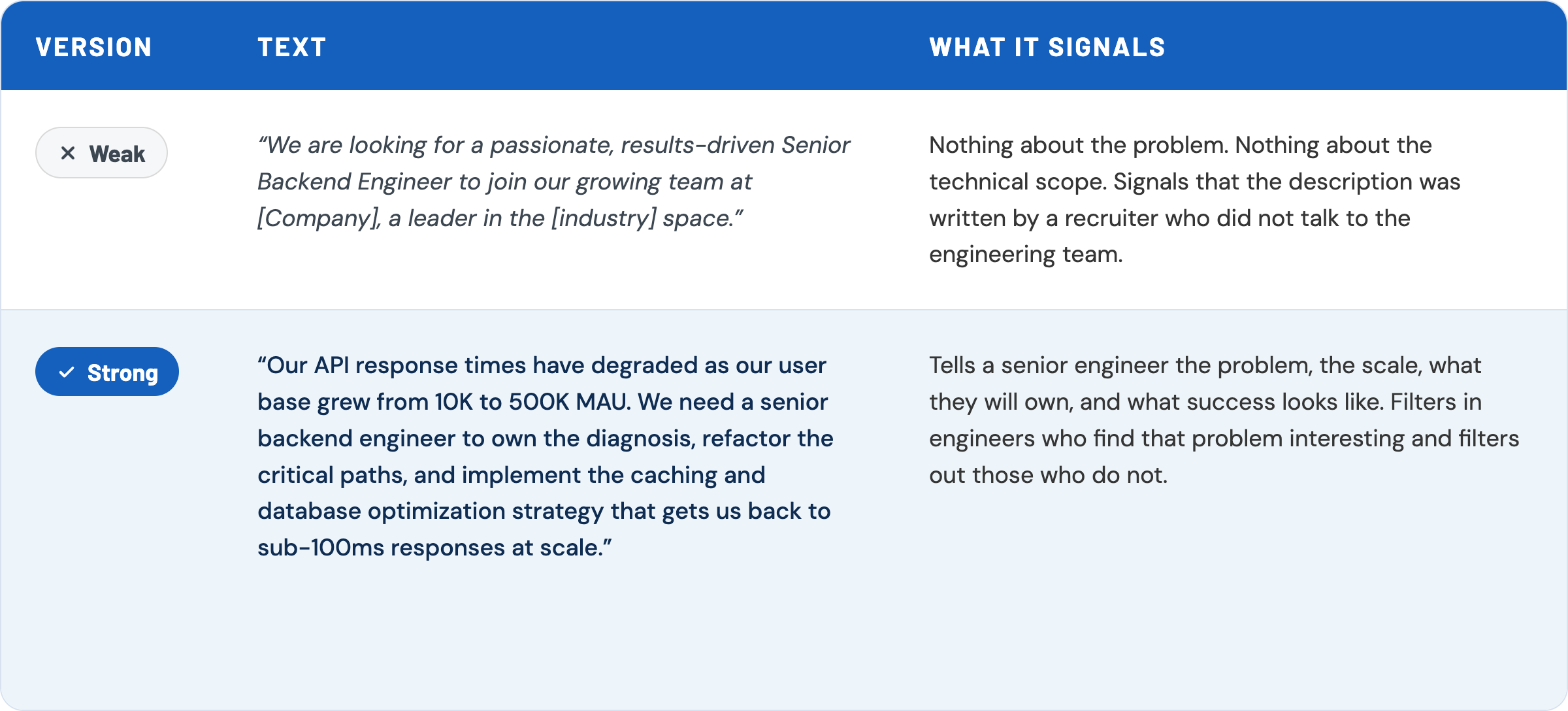
The problem statement does not need to be comprehensive. It needs to be honest and specific enough that a senior engineer can form a mental model of whether this is work they want to do. Three sentences that describe the real challenge are worth more than three paragraphs of company positioning.
2. The Primary Stack (Required) vs. Secondary Stack (Preferred)
List the technologies the engineer will spend 80% of their time in as required. List everything else as preferred or nice-to-have. The practical rule: if an engineer could be productive in this role without knowing a technology in week one, it is a preferred skill, not a required one.
Common mistakes:
- Requiring all technologies in the codebase, not just the ones the engineer will actively use.
- Listing framework experience at the wrong level of specificity: ‘AWS’ is not a requirement; ‘EC2, RDS, and Lambda’ is.
- Including technologies the team is evaluating or considering adopting, not ones already in use.
- Adding ‘nice to haves’ that are actually requirements, which forces candidates to self-filter on qualifications they would have met if described accurately.
A rule of thumb for stack depth: If you have a senior engineer on your team read the stack section, could they describe a realistic week of work in this role based on the technologies listed? If not, the stack description is either too broad or too vague.
3. Team Context
Senior engineers evaluate the team they will join as carefully as the problem they will solve. They have worked on high-functioning and low-functioning teams, and they have developed pattern recognition for the difference. The team context section is your opportunity to demonstrate that your team is worth joining.
What to include:
- Team size and the composition (how many senior vs. junior, how many frontend vs. backend, how many full-time vs. augmented).
- Who the engineer reports to and what that person’s technical background is.
- Whether this is a greenfield product or a brownfield codebase with existing technical debt.
- What the sprint cadence looks like and how architectural decisions get made (top-down, RFC process, engineering committee, etc.).
- One or two honest sentences about what is genuinely hard about working on your team. Senior engineers trust honesty more than they trust polish.
The one sentence most job descriptions are missing: a truthful description of the codebase reality. A description that says ‘modern tech stack’ when the reality is a 10-year-old Rails monolith with significant technical debt will produce a bad hire who leaves when they discover the truth. The engineers who are genuinely excited about a legacy modernization challenge will only apply if you tell them that is what they are signing up for.
4. Seniority Signals (Competencies, Not Years)
Years of experience is the weakest proxy for engineering seniority available. A developer with 8 years of experience who has worked at one company in one codebase and has never made an architectural decision is not a senior engineer. A developer with 4 years who has owned a critical system through a scaling event, made architectural decisions with production consequences, and mentored junior engineers is.
Replace years-of-experience requirements with competency signals: specific things the engineer has done or can do that are directly relevant to the role.

5. The Application Process
Tell engineers exactly what happens after they apply. What is the process? How many stages? Is there a take-home challenge, and is it paid? How long does each stage take? How quickly will they hear back? Senior engineers are evaluating multiple opportunities simultaneously. A vague ‘we’ll be in touch’ closing is a signal about your company’s operating style, and it is not a favorable one.
Bad example: ‘We look forward to reviewing your application and will be in touch with next steps.’
Good example: ‘Our process has three stages: a 30-minute introductory call, a take-home architecture challenge in your primary stack (3–4 hours, paid at your equivalent hourly rate), and a 90-minute technical interview covering the challenge and system design. You will hear from us within 48 hours at each stage. The whole process takes 2–3 weeks.’
The paid take-home challenge signals respect for the engineer’s time and seriousness about the role. According to Stack Overflow’s 2024 developer research, unpaid take-home challenges are one of the top reasons senior engineers drop out of hiring processes they were otherwise interested in, particularly when the challenges exceed 4 hours.
Writing a Staff Augmentation Role Brief
When working with a staff augmentation provider like Bluelight, the ‘job description’ becomes a role brief: a shorter, more targeted document that guides the vetting process. The role brief does not need to sell the company to candidates, Bluelight handles positioning. It needs to be precise about technical requirements, team context, and communication expectations.
Bluelight’s account managers work with clients to convert role requirements into a precise vetting brief before sourcing begins. Clients who provide a specific brief including a first deliverable and explicit communication requirements consistently see shorter sourcing cycles and fewer replacement requests. The brief drives the coding challenge design, the English evaluation scenario, and the candidate shortlist. Vague briefs produce accurate matches only by luck.
When you're ready to define the role, start with how Bluelight structures the vetting process → https://bluelight.co/our-process
Role-Specific Writing: How the Formula Changes by Discipline
The five-component structure above applies to all engineering roles. The emphasis shifts by discipline.
Senior Backend Engineers
Lead with the system they will own: ‘You will own our payments API and the authentication service. Both are in production, serving X requests per day, with the following known scaling issues.’ Backend engineers evaluate whether the systems are interesting and whether the architecture decisions they will inherit are defensible. A description that vaguely promises ‘exciting challenges at scale’ signals that the writer has not thought carefully about what the role actually involves.
Senior Frontend Engineers
Lead with the product surface and the design system reality: ‘Our frontend is React with TypeScript, running in a Next.js monorepo. We have a design system in early stages you will contribute to its development alongside the product designer.’ Frontend engineers care about the product they will build and the design relationship. They also want to know whether the codebase has TypeScript, whether testing is enforced, and whether the company takes accessibility seriously. Mention all three explicitly.
DevOps and Platform Engineers
Lead with the infrastructure you run and the scale it needs to support: ‘We run on AWS (ECS + RDS + SQS), with a GitHub Actions CI/CD pipeline that currently lacks automated testing gates. You will own the pipeline, the environment parity between staging and production, and the observability stack.’ Platform engineers evaluate scope of ownership and technical debt honestly. ‘Build our DevOps practice’ is only attractive to the engineers who want greenfield authority say it explicitly if that is what you are offering.
AI/ML Engineers
Lead with the specific ML problem, not the general AI enthusiasm: ‘We are building a recommendation engine for content personalization. Our training data is X. We are evaluating PyTorch versus TensorFlow for the model layer and have not decided.’ ML engineers evaluate dataset quality, infrastructure maturity, and whether the team has the product discipline to define good evaluation metrics. Generic ‘AI-first company’ language signals that the ML use case has not been thought through operationally.
The Three Mistakes That Filter Out Exactly the Engineers You Want
Mistake 1: Experience requirements that do not match the available talent. Requiring 10+ years of Node.js when Node.js has been mainstream for 12 years and most senior practitioners have 5–7 years of production experience tells a senior engineer that the requirements were generated by a tool or copied from another job description. It is a signal about organizational rigor, and it filters out senior engineers who meet the real requirements but not the inflated ones.
Mistake 2: Compensation described as ‘competitive’ without specifics. ‘Competitive salary’ is noise. Senior engineers who have been through multiple hiring processes know that ‘competitive’ means the company either has not decided, does not want to anchor early, or is below market and hoping candidates won’t notice until they have emotionally committed to the process. The companies that publish salary ranges attract senior engineers at a higher rate than those that do not, because transparency signals confidence that the offer is actually competitive.
Mistake 3: Culture descriptions that say nothing specific. ‘Fast-paced environment,’ ‘passionate about technology,’ ‘collaborative culture’ — none of these communicate anything that differentiates your company from 10,000 others using the same phrases. Senior engineers who have worked at multiple companies know these phrases are filler. One honest, specific sentence about what is genuinely difficult about the role or your company is worth more than a paragraph of generic culture marketing.
"Bluelight has provided a team of seven high-quality engineers. They communicate via virtual meetings, email, and a messaging app. Overall, the client is impressed with their adaptability and professionalism."
— Ramana Thumu, CTO & CPO, Fanatics Inc.
Frequently Asked Questions
What should a technical job description include?
A problem statement (what engineering challenge this role exists to solve), the primary stack as required and secondary stack as preferred, team context including codebase reality and decision-making structure, seniority signals as competencies not years, and an explicit description of the application process with timelines.
How do I write a job description that attracts senior engineers?
Lead with the specific technical problem, not a company overview. Use competency-based seniority requirements instead of years of experience. Be honest about the codebase reality. Describe the application process in detail. If offering a take-home challenge, make it paid.
What is the difference between a job description and a staff augmentation role brief?
A job description markets the role to candidates. A staff augmentation role brief gives the provider’s vetting team the technical requirements, seniority competencies, communication expectations, and first deliverable needed to source and screen accurately. The brief is shorter, more precise, and does not need to sell the company, the provider handles positioning.
Why are most engineering job descriptions ineffective?
They list too many required technologies, use years of experience as a seniority proxy, describe culture with generic phrases that carry no differentiating information, and do not describe the actual technical problem the engineer will own. Senior engineers self-select on problem interest a description that does not describe the problem clearly loses them in the first 30 seconds.
How does Bluelight use a role brief to match engineers?
Bluelight’s account managers convert role requirements into a vetting brief that drives the coding challenge design, the English proficiency evaluation scenario, and the candidate shortlist. Clients who provide specific briefs, including a first deliverable and explicit communication requirements consistently see 7–14 day onboarding timelines and fewer replacement requests than clients with vague briefs.
More cost-effective than hiring in-house, with Nearshore Boost, our nearshore software development service, you can ensure your business stays competitive with an expanded team and a bigger global presence, you can be flexible as you respond to your customers’ needs.
Learn more about our services by booking a free consultation with us today!


