

Table of Contents
- What Is a Nearshore Development Team?
- Design Your Nearshore Development Team Around Ownership, Not Headcount
- Set Working Agreements Before Sprint One
- How to Manage a Remote Development Team Day to Day
- Metrics That Show a Nearshore Team Is Working
- Four Failure Patterns and How to Fix Them
- When to Restructure the Team
- Frequently Asked Questions
- What is a nearshore development team?
- How do you manage a remote development team?
- How many hours of overlap does a nearshore team need?
- Who manages a nearshore development team?
- What is the difference between a nearshore development team and staff augmentation?
- How do you measure a nearshore team's performance?
- Key Takeaways
A nearshore development team works when you design how it operates before the first engineer joins. Most failures come from unclear ownership and loose communication rules, not from engineering skill. This guide covers the structure, working agreements, and metrics CTOs use to keep a nearshore team shipping alongside in-house engineers.
What Is a Nearshore Development Team?
A nearshore development team is a group of engineers in a nearby country who work your business hours and plug into your delivery process. For US companies, that usually means Latin America. Overlap with US time zones lets the team join standups, code reviews, and incident calls live.
You can set one up in two main ways. Through nearshore staff augmentation, vetted engineers join your existing team and report to your leads. A dedicated development team arrives as a pre-assembled group with a partner project manager who handles day-to-day operations. The right choice depends on who manages the work.
The table below compares both options with in-house hiring as a baseline.
| Option | Who manages day to day | Best when |
|---|---|---|
| Staff augmentation | Your engineering leads | You have a working team and need senior capacity or a missing skill |
| Dedicated team | A partner project manager, with your product owner setting priorities | You need a full product track built and your leads are at capacity |
| In-house hiring | Your engineering leads | The role is permanent and central to your product |
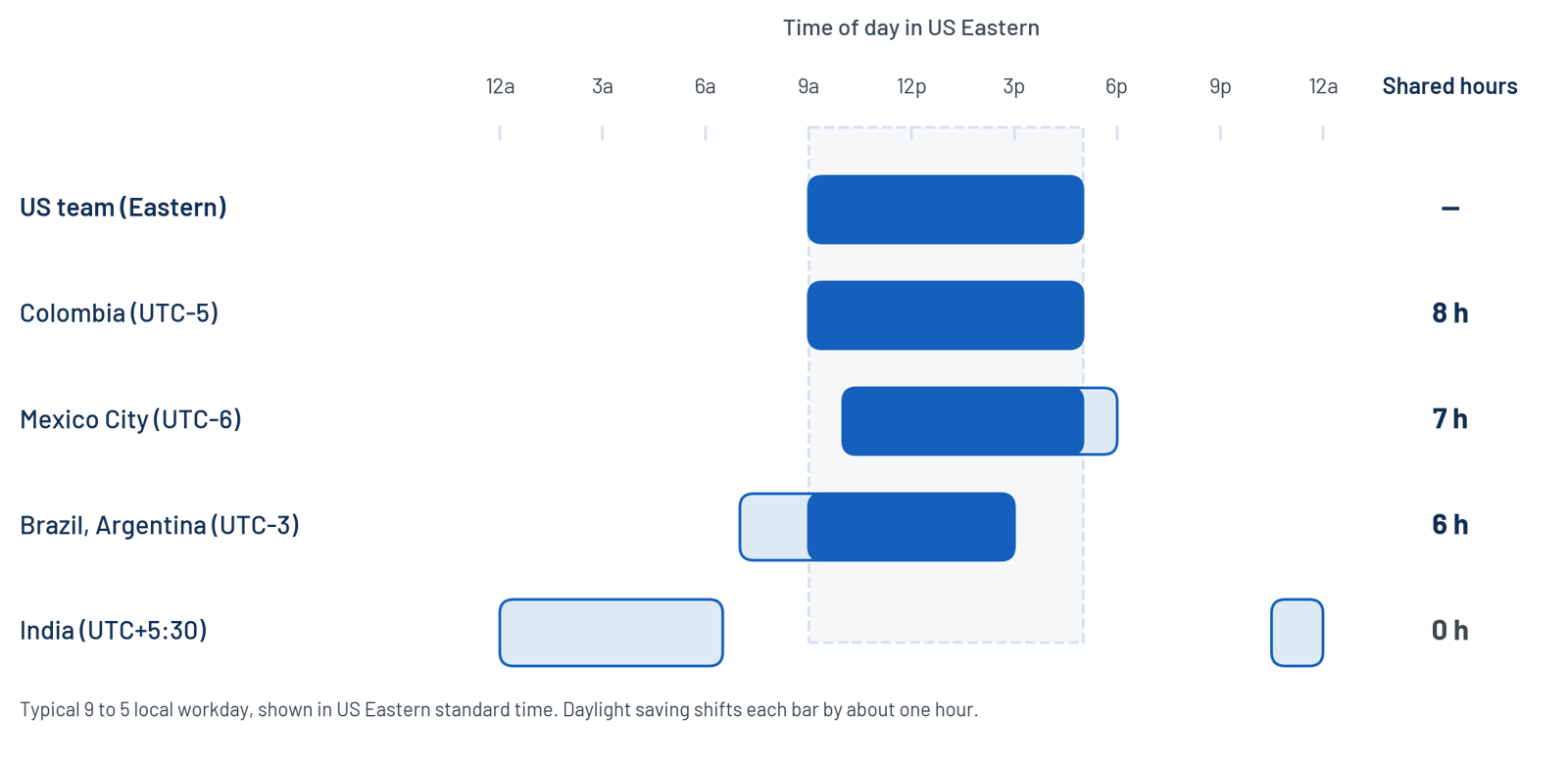
Shared working hours between a US team and nearshore locations, compared with an offshore location.
Design Your Nearshore Development Team Around Ownership, Not Headcount
In 1968, Melvin Conway observed that organizations that design systems produce designs that copy their communication structures. The same rule applies to a mixed team. If engineers share a backlog but not ownership, the code reflects that split.
Give the nearshore engineers a real slice of the product. Assign a service, a feature area, or a platform capability, with its own backlog and a named tech lead. Avoid a setup where one group writes tickets and another executes them.
- One backlog per team. Nearshore and in-house engineers on the same team plan from the same list.
- One accountable lead per area. That person approves designs and owns the quality bar.
- Shared code ownership. Reviewers come from both sides of the team, not only from headquarters.
- Written decision rights. State which choices an engineer can make alone and which need sign-off.
A reachable product owner matters just as much. Engineers without product context build to the ticket, not to the problem.
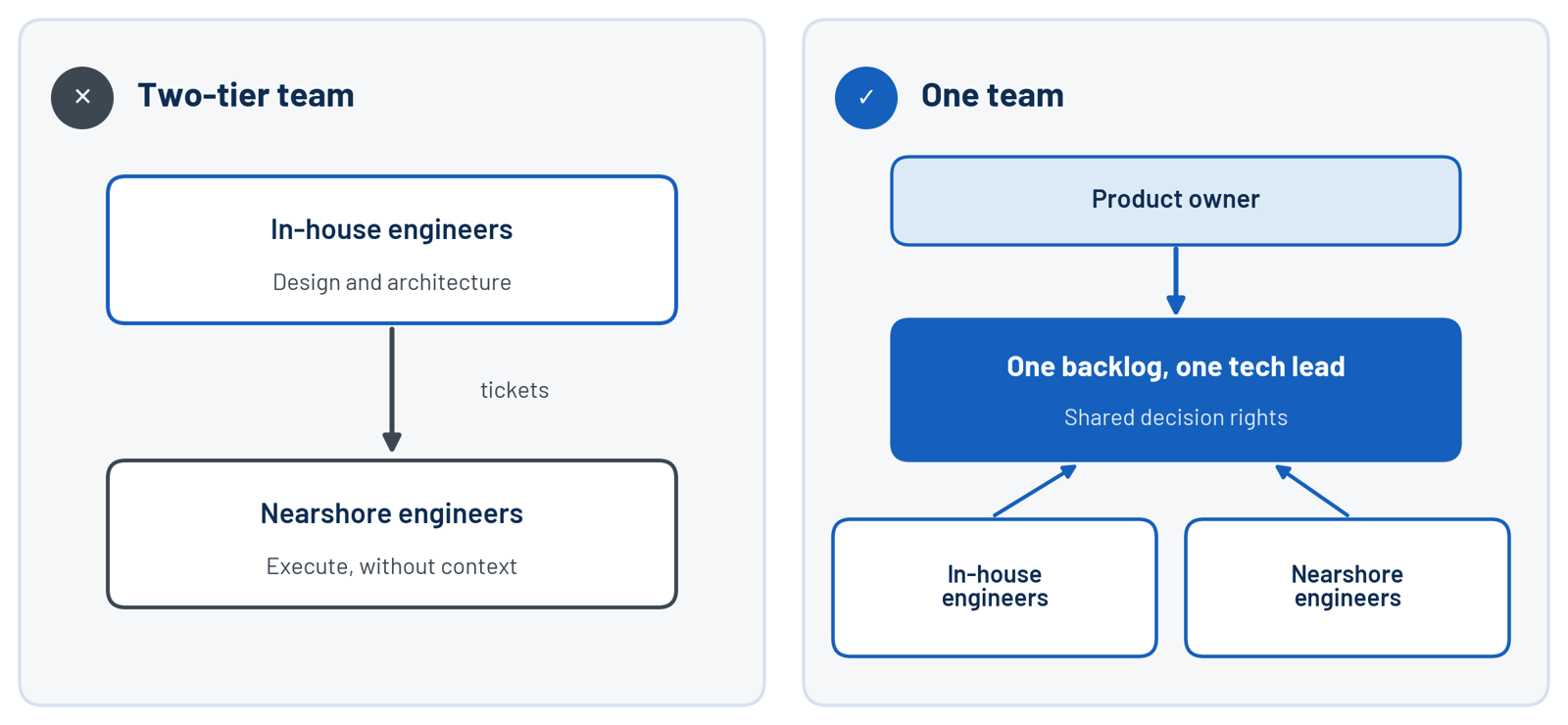
A two-tier setup splits context from execution. One team shares a backlog and a tech lead.
Set Working Agreements Before Sprint One
A working agreement is a short written set of rules for how the team collaborates. Write it with your engineering leads and the nearshore engineers together. Keep it to one page and revisit it at the first retrospective.
These six agreements cover most of the friction teams report in the first month.
| Agreement | What to decide | Example rule |
|---|---|---|
| Core hours | The daily window when everyone is online | Everyone is reachable for the same four hours each day |
| Response time | How fast blocking questions get answered | Blocking questions get a reply within one hour during core hours |
| Pull request review | Reviewer rotation and turnaround | First review within four working hours |
| Definition of done | Tests, docs, and review required to close a ticket | No ticket closes without tests and updated docs |
| Escalation | Who to contact when work is blocked | Tech lead first, engineering manager second |
| Documentation | Where decisions are recorded | Architecture decisions live in the repository |
These rules slot into the systems you already run. Bluelight engineers use your tools and processes, and collaborate with your team in Slack in real time.
How to Manage a Remote Development Team Day to Day
You do not need new rituals to manage a remote development team. You need to run your existing ones consistently.
- Standups. Hold one standup for the whole team at a time that works for everyone. Do not run a separate standup for the nearshore group.
- Sprint planning and reviews. Run two-week sprints with a review at the end of each, the cadence Bluelight uses by default. Demo working software, not status slides.
- Retrospectives. Use them to adjust working agreements. A rule nobody follows needs rewriting, not enforcing.
- One-on-ones. Each engineer meets their direct lead weekly. Add a monthly skip-level check-in during the first quarter.
- Written context. Record decisions in the repository or wiki, not in direct messages. New engineers then read the same history as everyone else.
Manage outcomes, not hours. Bluelight logs time in Toggl for transparency, but the signal that matters is delivered work and how it performs in production. For a shorter list of collaboration habits, see tips for successful nearshore software development.
Metrics That Show a Nearshore Team Is Working
Pick a small set of delivery metrics and compare the whole team before and after the nearshore engineers join. DORA's four keys cover throughput and stability: change lead time, deployment frequency, change failure rate, and failed deployment recovery time. DORA's research finds that these metrics move together for most teams, so read them as a set.
Review these five signals monthly. The first four come from DORA, and the fifth catches review bottlenecks early.
| Metric | What it tells you | Warning sign |
|---|---|---|
| Change lead time | How fast a commit reaches production | Rising after new engineers join |
| Deployment frequency | How often you ship | Flat or falling despite higher headcount |
| Change failure rate | How often releases cause incidents | Climbing as the team grows |
| Failed deployment recovery time | How fast you restore service | Longer recovery when ownership is unclear |
| Pull request review time | How long code waits for feedback | Reviews stalled on one side of the team |
Time zone alignment shows up in these numbers. Bluelight's nearshore benchmark found that nearshore engineers completed the same change request 84% faster than an offshore team, because questions were answered the same day.
Four Failure Patterns and How to Fix Them
Four patterns account for most struggling nearshore engagements.
- The two-tier team. Nearshore engineers receive tickets while in-house engineers receive design work. Rotate design ownership and include nearshore leads in architecture reviews.
- Context starvation. Engineers never learn why a feature matters. Run a product walkthrough in week one and share customer call recordings.
- Hidden knowledge. Answers live in private messages and one person's head. Move decisions to shared channels and the repository.
- Uneven review. Pull requests from one group wait longer than the other. Set a review rotation and one turnaround rule for everybody.
Want a team that already works in your time zone? Bluelight engineers join your standups and use your tools, and a 2-week risk-free trial lets you test the fit first. Expand Your Team →
When to Restructure the Team
Revisit the setup when delivery metrics stall for two sprints, when a lead cannot give each engineer a weekly one-on-one, or when the team's scope has outgrown its original charter.
Smaller squads often help. The engineering team scaling guide covers that split. If you are weighing a project-manager-led team against embedded engineers, the IT team engagement models guide compares the structures.
Frequently Asked Questions
What is a nearshore development team?
A nearshore development team is a group of engineers in a nearby country who work your business hours and join your delivery process. For US companies, the engineers typically sit in Latin America, within zero to three hours of US Eastern time.
How do you manage a remote development team?
Run the same rituals you use for in-house engineers: one standup, shared sprint planning, regular reviews, and weekly one-on-ones. Write down working agreements, record decisions in shared places, and measure outcomes instead of hours.
How many hours of overlap does a nearshore team need?
Plan for at least four shared hours a day for standups, reviews, and unblocking. Nearshore engineers in Mexico, Colombia, Brazil, Argentina, and Chile cover most of the US workday, so the overlap is usually larger than that.
Who manages a nearshore development team?
It depends on the model. With staff augmentation, your engineering leads manage the engineers directly. With a dedicated team, a partner project manager handles day-to-day operations, reporting, and milestones, while your product owner sets priorities.
What is the difference between a nearshore development team and staff augmentation?
Staff augmentation adds individual engineers to your existing team under your management. A dedicated development team is a pre-assembled group, with roles such as developers, QA, and a project manager, that delivers a product track end to end.
How do you measure a nearshore team's performance?
Track DORA's four delivery metrics before and after the team joins, plus pull request review time. Compare team-level results, not individual output.
Key Takeaways
- A nearshore development team succeeds on structure: clear ownership, one backlog, and named leads, not on headcount.
- Write a one-page working agreement covering core hours, response time, review turnaround, definition of done, and escalation.
- Run the same standups, sprint reviews, and one-on-ones you use in-house. Do not create a parallel process for the nearshore group.
- Measure delivery with DORA's four keys plus review time, and compare the whole team before and after new engineers join.
- Time zone alignment shortens feedback loops. Bluelight's benchmark shows nearshore engineers completing change requests 84% faster than an offshore team.
More cost-effective than hiring in-house, with Nearshore Boost, our nearshore software development service, you can ensure your business stays competitive with an expanded team and a bigger global presence, you can be flexible as you respond to your customers’ needs.
Learn more about our services by booking a free consultation with us today!


