

QA outsourcing means moving part of your testing work to engineers outside your core team. For a CTO, the real decision is how those testers join your delivery process. You keep test strategy and release criteria. Nearshore QA engineers add execution capacity inside your sprints, your tools, and your time zone.
What Is QA Outsourcing?
QA outsourcing, also called software testing outsourcing, is the practice of assigning testing work, such as regression testing, test automation, or exploratory testing, to people outside your internal team.
Three models cover most arrangements. They differ mainly in who owns the testing process.
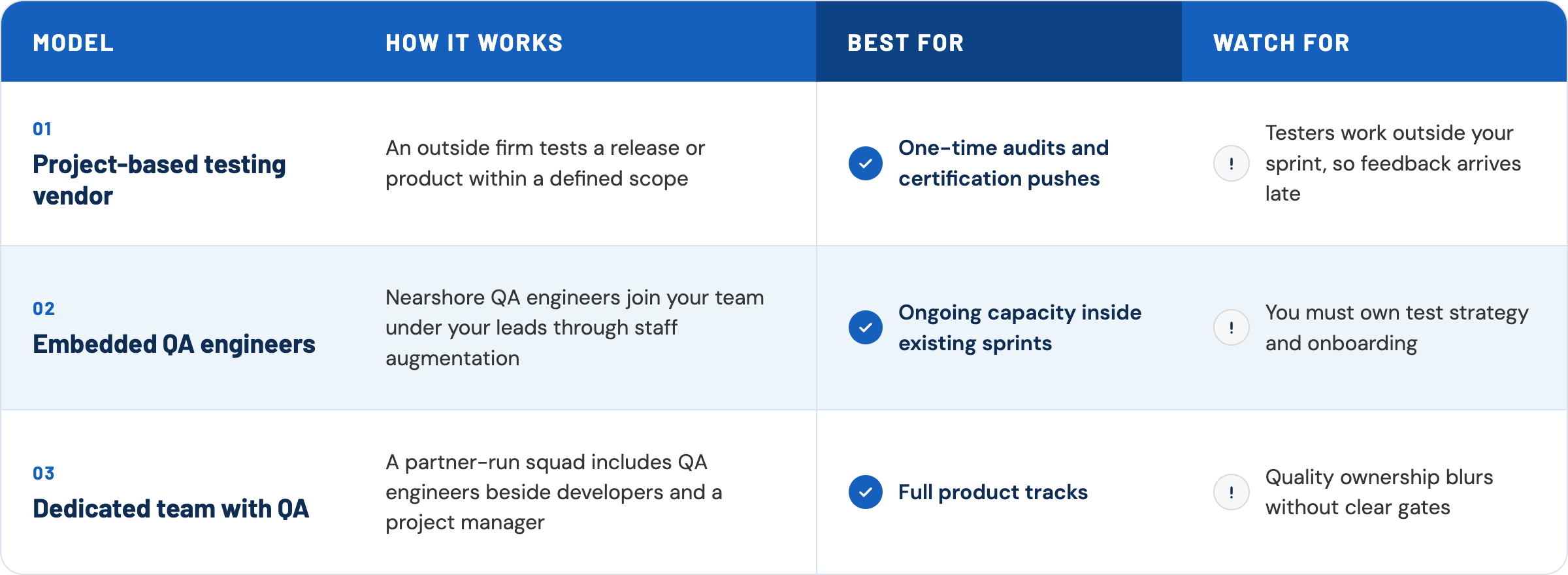
Most QA work at Bluelight is delivered inside nearshore staff augmentation and dedicated team engagements, so testers work in your sprints rather than beside them. You can read more about the discipline on the software testing and QA page.
When QA Outsourcing Makes Sense
Look for these signals before you add testers.
- Releases wait on a manual regression pass that takes days.
- Developers write most of the tests and skip exploratory testing.
- Escaped defects keep reaching customers, and the same areas break twice.
- Your automated suite is thin, and nobody has time to build it.
Hold off if nobody owns quality today. Outside testers amplify a process, but they cannot replace one. Name an internal quality owner first, even a part-time one, and define what "ready to release" means.
Manual vs Automated Testing: What to Hand Off
The test pyramid is a useful guide. It recommends many fast unit tests, fewer integration tests, and a small number of broad end-to-end tests. QA engineers add the most value around that base.
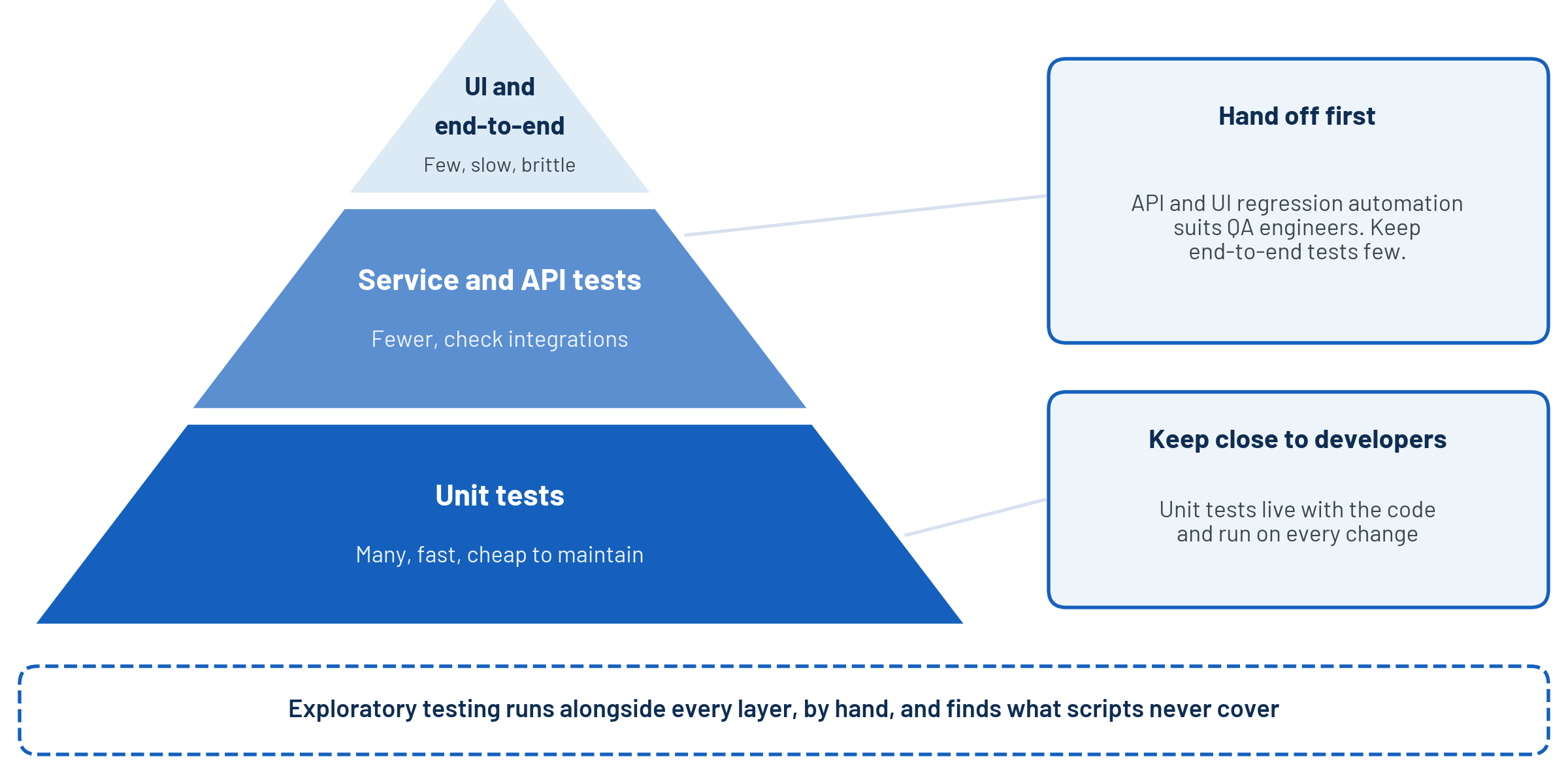
Use this split to decide what to hand off and what to keep.

Manual testing still matters. Exploratory testing finds problems that scripted checks never cover. Automation protects what already works.
Which QA Profile Do You Need?
QA is not one skill. Match the profile to the gap you found.
Three profiles cover most QA staffing needs.
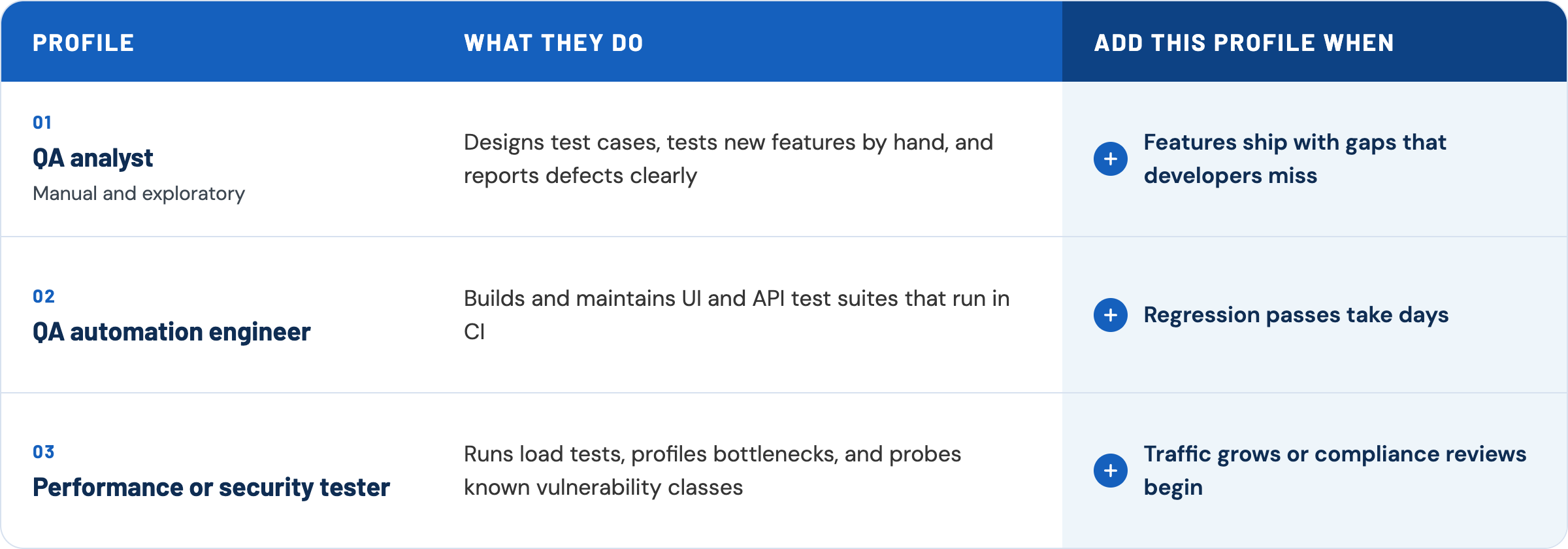
Bluelight QA engineers work with tools such as Selenium, Cypress, Appium, JMeter, BrowserStack, and TestRail. They cover unit, integration, functional, end-to-end, acceptance, performance, smoke, and regression testing.
How to Add Nearshore QA Engineers Without Slowing Releases
- Set the quality gate. Write down what must pass before a release: coverage on critical paths, no open severity-one defects, and a green pipeline.
- Embed testers in the sprint. QA engineers join planning and refinement, so they test stories while developers still remember the code. Do not run QA as a downstream phase.
- Give full access. Provide repositories, CI pipelines, staging, and test data on day one.
- Start with regression automation. It delivers visible value early and frees your developers.
- Pair each tester with a developer lead for the first sprint. The tester learns the product, and your team learns what the tester needs.
- Review at two weeks. Check defect findings, suite stability, and team feedback during the trial period.
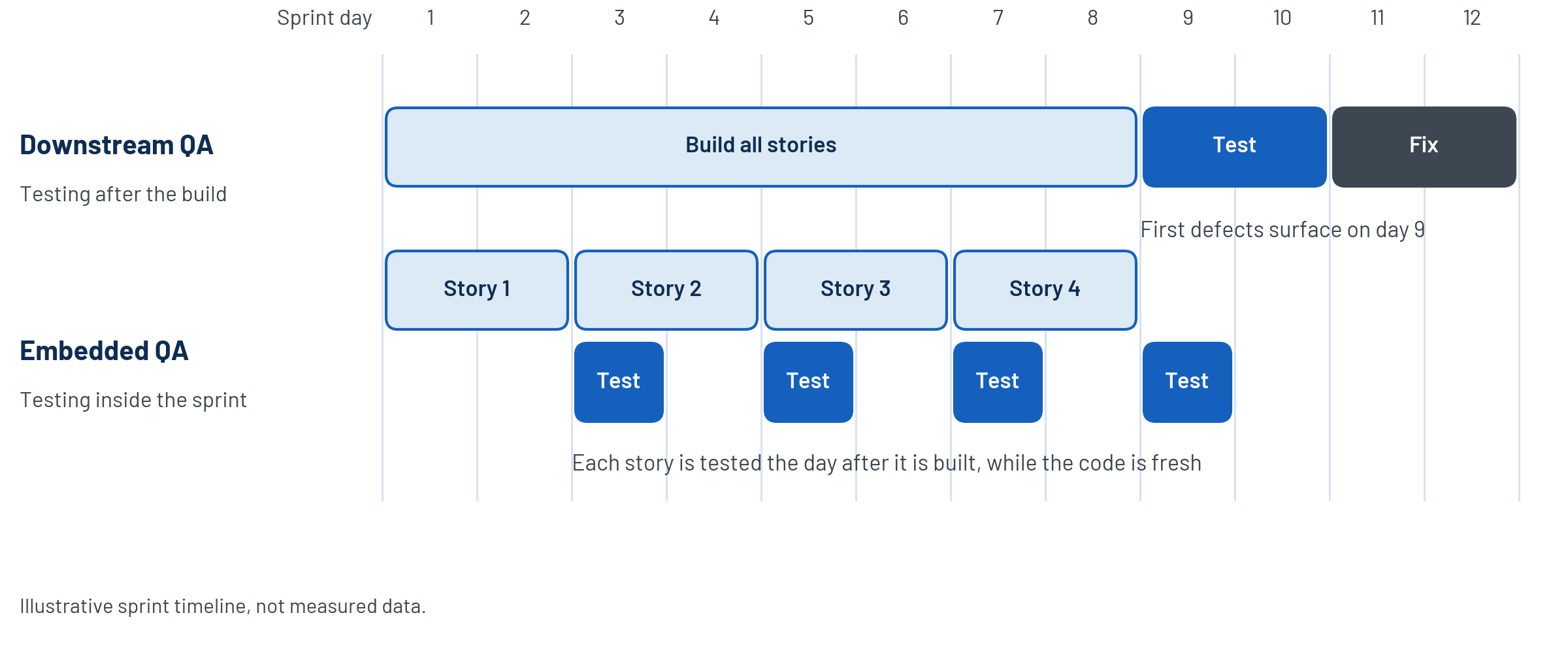
Illustrative sprint: embedded testing surfaces defects while the code is still fresh.
Bluelight QA engineers join through staff augmentation or a dedicated team, and the first two weeks run as a risk-free trial. Start Hiring →
Time zone alignment matters here. A defect report raised during overlap hours gets fixed that day, not the next morning. Bluelight's nearshore benchmark measured an 84% faster change request cycle for nearshore engineers than for an offshore team. Defect fixes that follow testing benefit from the same same-day feedback loop.
Questions to Ask Before You Commit
A short interview run by your engineering lead tells you more than any proposal. Ask these six questions and listen for specific stories, not definitions.
- Which part of your last test suite did you build, and how did you keep it stable?
- How do you decide what to automate and what to test by hand?
- Describe a defect you found that developers had missed. What did you do next?
- How do you handle a flaky test that blocks a release?
- What do you need from developers to test a story well?
- How do you report quality status to a non-technical stakeholder?
-
At Bluelight, clients can watch recorded candidate assessments and technical interview answers before they schedule an interview. You see how a tester reasons about a problem before you invest a full interview cycle.
Metrics That Show Quality Is Improving
Measure outcomes, not test counts. DORA's change failure rate tracks how often a release causes a production incident, which makes it the clearest single measure of delivery quality.
Track these five measures before the QA engineers join and every month after.

Quality When Developers Use AI Assistants
AI coding tools raise the volume of code that needs verification. Stack Overflow's 2025 Developer Survey found that 46% of developers do not trust the accuracy of AI tool output, up from 31% a year earlier.
That skepticism is healthy. It means reviews and tests matter more as generated code enters your codebase. Dedicated QA capacity gives your team a second line of defense without slowing developers down.
QA Outsourcing Mistakes to Avoid
- Do not test downstream. Testers who only receive finished builds find problems after changes have become expensive. Bring them into planning and refinement instead.
- Do not leave quality without an owner. Test results go unread when nobody is accountable for them. Name that person before the testers start.
- Measure outcomes, not test counts. A large suite full of flaky tests protects nothing. Track change failure rate and escaped defects instead.
- Transfer knowledge as you go. Document test plans and frameworks while you build them, so quality never depends on one person.
- Do not cut QA because releases look stable. Stable releases usually mean your testing is working. Remove it and the failures return.
Frequently Asked Questions
What is QA outsourcing?
QA outsourcing is the practice of assigning software testing work, such as regression testing, test automation, or exploratory testing, to people outside your internal team. It ranges from a single testing project to QA engineers embedded in your daily sprints.
What is the difference between QA outsourcing and QA staff augmentation?
QA outsourcing is the broad term for assigning testing work externally. Staff augmentation is one way to do it: nearshore QA engineers join your team and work under your leads, instead of testing separately as an outside vendor.
Should you automate all testing?
No. Automate repeatable regression and API checks. Keep exploratory testing manual, because people find unexpected problems that scripts do not cover.
What should stay in-house when you outsource QA?
Keep test strategy, release criteria, and acceptance of business rules. Those reflect your risk tolerance and your product decisions.
How do you onboard QA engineers quickly?
Provide repository, pipeline, staging, and test data access on day one. Embed them in sprint planning, pair them with a developer lead, and start with regression automation.
How do you measure QA performance?
Track change failure rate, escaped defects, regression cycle time, flaky test rate, and defect fix time. Compare each one before and after the QA engineers join.
Key Takeaways
- QA outsourcing works best when testers join your sprints. You keep strategy and release criteria, and they add execution capacity.
- Name an internal quality owner before you add outside testers. They amplify a process but cannot replace one.
- Hand off regression suites, framework upkeep, exploratory testing, and environment setup. Keep strategy and business-rule acceptance in-house.
- Measure outcomes with change failure rate, escaped defects, regression cycle time, flaky test rate, and defect fix time.
- Overlap hours turn defect reports into same-day fixes, and AI-assisted coding makes that verification layer more valuable.
More cost-effective than hiring in-house, with Nearshore Boost, our nearshore software development service, you can ensure your business stays competitive with an expanded team and a bigger global presence, you can be flexible as you respond to your customers’ needs.
Learn more about our services by booking a free consultation with us today!


