
Staff augmentation is not a permanent state it is a tool with a specific operating window. When the conditions that made augmentation the right choice change, the right answer changes with them. CTOs who keep augmenting past that window end up with higher long-term costs, institutional knowledge that lives with a vendor, and engineers who are not invested in the product outcome. This framework gives you five specific signals to watch and a clear decision process for each scenario.
The Conditions That Make Staff Augmentation the Right Model
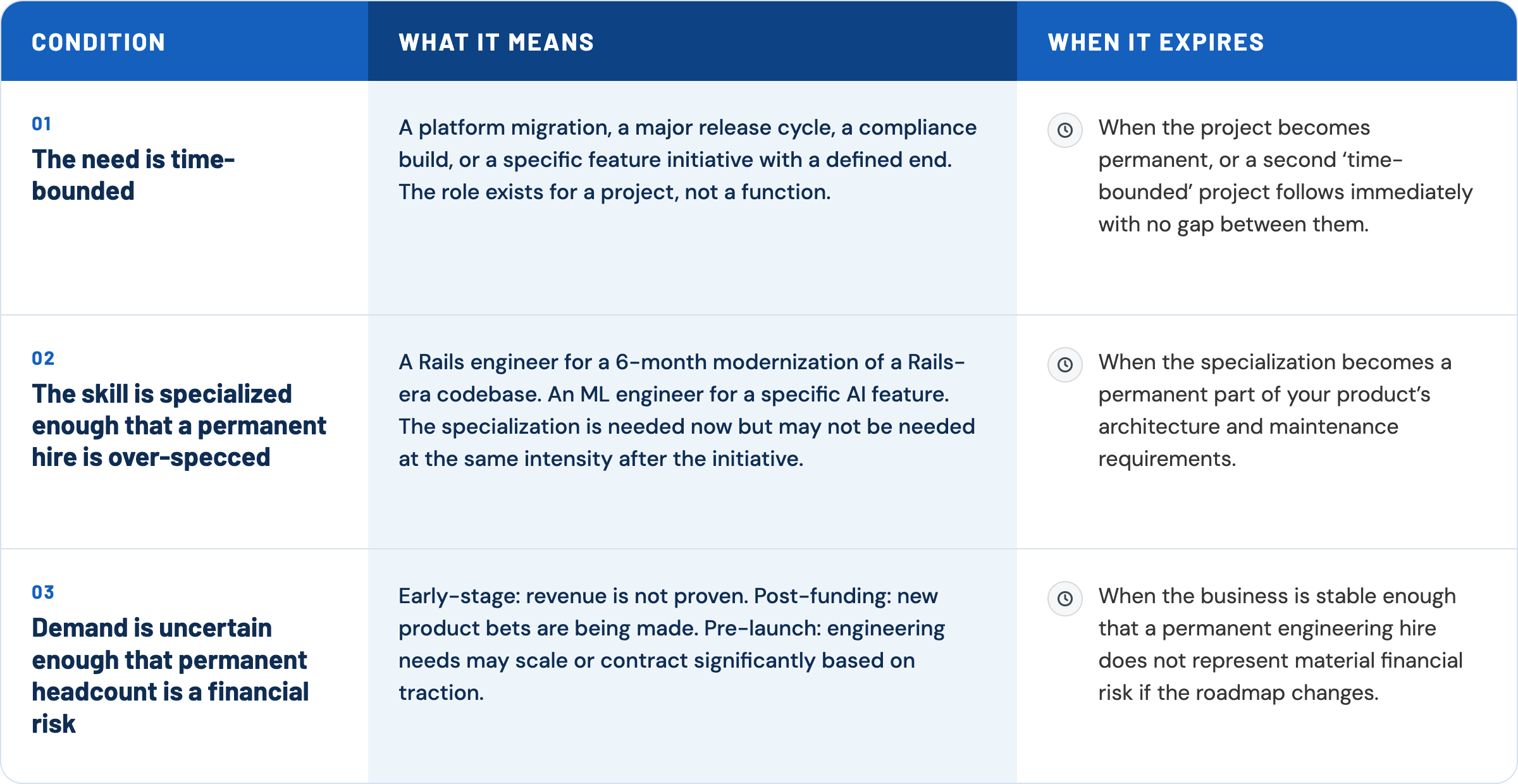
Staff augmentation earns its place in three specific conditions. When those conditions no longer hold, the model stops being optimal.
The 5 Signals That It Is Time to Hire Full-Time
Signal 1: The Role Has Become Strategically Core
If an augmented engineer is making architectural decisions that shape your product’s direction, owning the codebase of your most critical feature, or carrying institutional knowledge that no internal engineer has, that role has become strategically core. Strategic roles should be owned by employees with long-term investment in the outcome, not rented from a vendor.
The diagnostic test: if this engineer left today, how would your product be affected in 30 days? 90 days? A year? If the honest answer includes phrases like ‘we’d be blocked,’ ‘no one else knows how that system works,’ or ‘we’d have to re-architect,’ the role is not augmentation territory anymore. It is a full-time engineering hire that has been funded through a vendor relationship.
Signal 2: You Have Re-Onboarded the Same Role More Than Once in 12 Months
Every re-onboarding cycle costs 2–3 weeks of reduced output from the incoming engineer, plus the internal senior engineers’ time on context transfer. If you have re-onboarded the same role more than once in 12 months, the accumulated cost of that churn may exceed the cost of a full-time hire who stays.
According to ParallelStaff’s 2026 staff augmentation guide, engineer retention is one of the most underrated metrics in provider evaluation because high turnover forces clients through re-onboarding cycles that compound across every sprint. The question is not whether turnover is the provider’s fault or the market’s it is whether the velocity cost of re-onboarding has exceeded the cost of permanent headcount.
A rough calculation: if your senior engineers spend 10 hours each re-onboarding a new augmented hire, and you have 4 senior engineers who each bill internally at $150/hr, each re-onboarding event costs $6,000 in senior engineer time alone, before accounting for the 2–3 week velocity dip of the incoming engineer. Two re-onboarding events per year for one role costs roughly $12,000+ in senior time, which is a meaningful fraction of the cost differential between augmentation and a permanent hire in the same role. Bluelight's placement guarantees exposure: a new engineer is on your team within 7–14 days of a replacement request, which means the productivity gap stays inside a single sprint rather than bleeding across two or three.
Signal 3: The Augmented Engineer Is Performing Management Functions
Staff augmentation contracts are structured around individual contributors. When an augmented engineer starts managing other engineers, running standups, making sprint assignments, conducting code reviews as a lead, or making hiring recommendations they are performing a function that carries institutional and legal weight beyond what the augmentation agreement covers.
This situation creates three compounding risks: the augmented engineer is acquiring organizational influence without the employment relationship that typically accompanies it, your internal engineers are reporting to or depending on someone who can leave with 30 days’ notice, and the management continuity of your team depends on a vendor relationship rather than an employment one. Management functions should sit with employees or partners with a long-term stake in the outcome.
Signal 4: The Role Has Been Continuously Filled for 12+ Months
A role that has been continuously filled by augmented engineers for more than 12 months is a permanent role with a temporary label. The business need did not resolve at 3 months, or 6, or 9. It has been continuously present for a year.
This signal is diagnostic regardless of whether the specific engineer in the role has changed. If you have filled the same role with two or three consecutive augmented engineers, you are running a permanent function through a vendor relationship and paying the vendor margin on every invoice as a permanent cost.
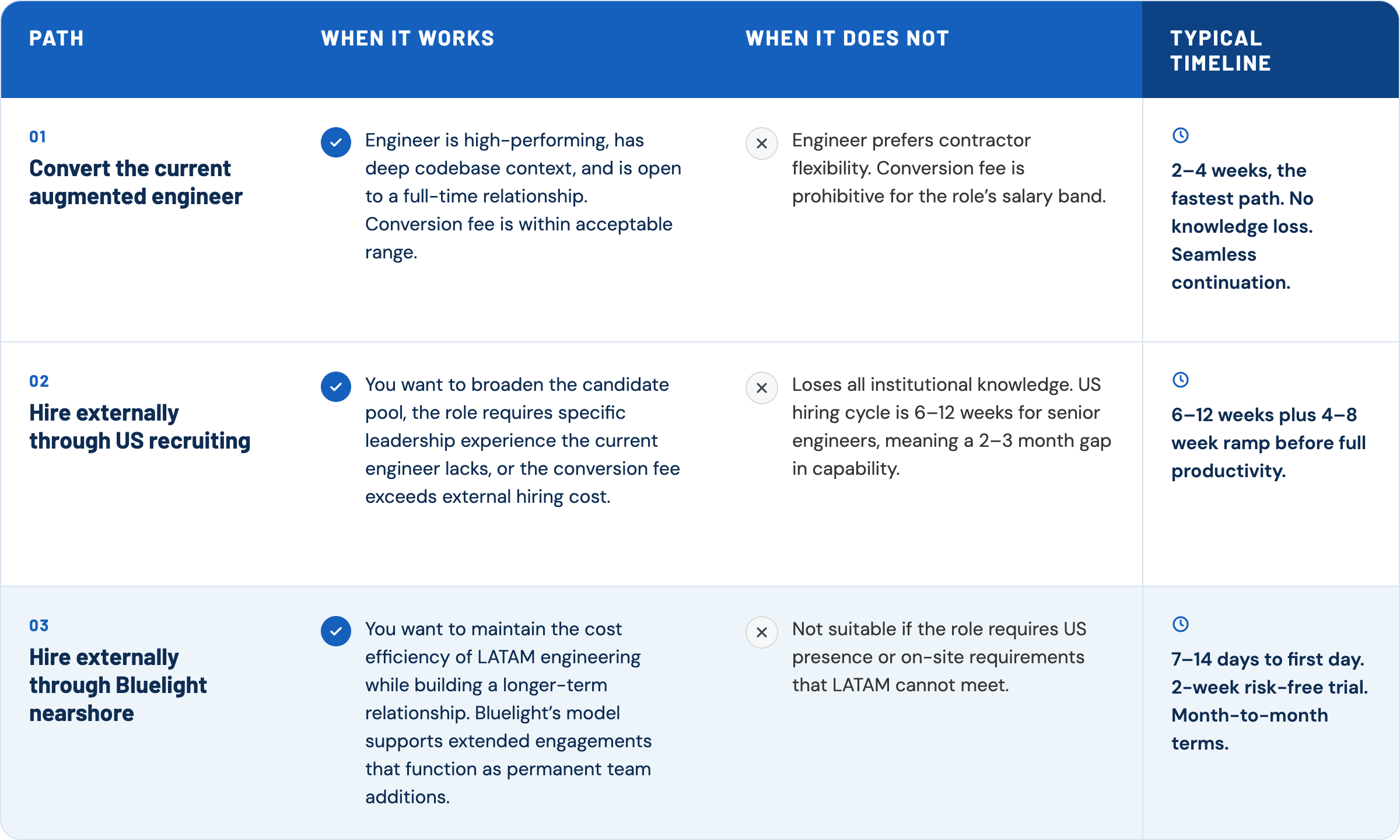
The practical decision: conduct an annual review of every augmented role that has been continuously filled for 12 months. If the business need has not changed and you cannot imagine the function going away in the next 12 months, convert the role to a permanent hire. Many companies discover at this point that converting the current augmented engineer through the contract’s conversion clause is faster than external hiring and preserves institutional knowledge.
Signal 5: Your Augmented-to-Full-Time Ratio Exceeds 1:2
At a ratio above 1 augmented engineer for every 2 full-time engineers, code review capacity typically becomes constrained, cultural cohesion weakens, and the management overhead on your full-time engineers grows. Senior engineers who are reviewing augmented engineer code in addition to their own sprint work have less time for architecture, mentoring, and the high-value technical judgment calls that only senior engineers make.
According to KORE1’s 2026 staff augmentation best practices, the 1:2 ratio reflects a practical review capacity boundary. Three contractors run well cost less and deliver more than six run badly and the second option bills significantly more over time. The ratio is a structural signal to rebalance toward permanent headcount, not a hard rule that applies identically to every team configuration.
The Full Cost Comparison: Augmentation vs. Full-Time over 24 Months
The cost comparison that actually determines which model is more efficient over time is not the hourly rate differential. It is the total cost including vendor margin, re-onboarding events, knowledge transfer overhead, and the lost option value of not building internal engineering capability.
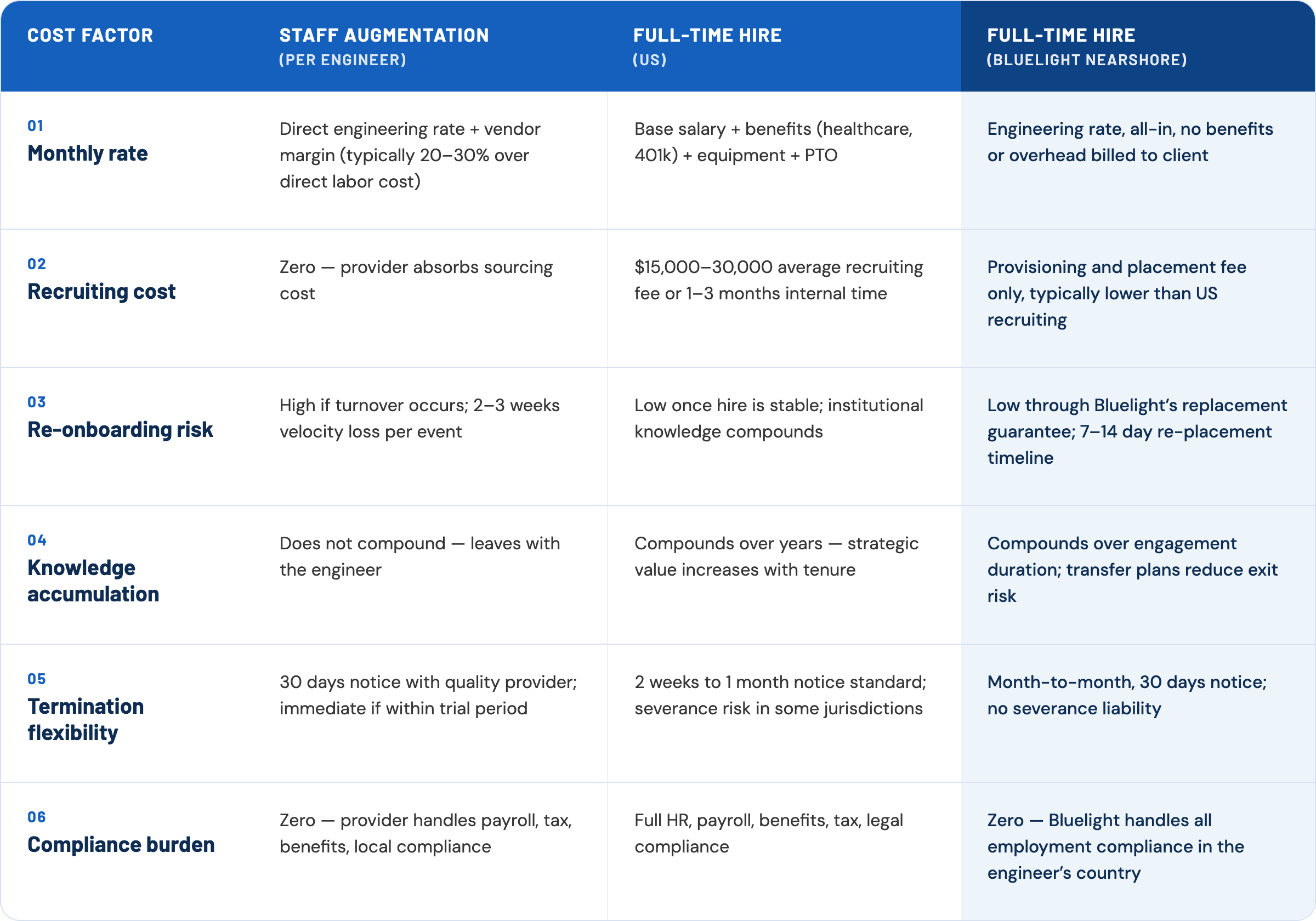
The practical inflection point where permanent hiring becomes more cost-efficient than augmentation is approximately 18 months for most US-based roles, and 24–30 months for nearshore roles where the rate differential is larger. Before that window, augmentation’s flexibility and lower overhead typically outweigh its margin cost. After it, permanent employment’s knowledge accumulation and reduced turnover risk typically outweigh its higher fixed cost.
The Conversion Decision: Keep the Engineer or Hire Fresh
When a role crosses from augmentation into permanent-hire territory, you have three paths.
What Permanent Hiring Requires That Augmentation Sidesteps
Before committing to permanent hiring, confirm that your organization is ready to absorb the HR function. Full-time hires require infrastructure that augmentation skips: a defined career ladder with growth paths, an annual review and compensation cycle, benefits administration, equipment provisioning and lifecycle management, onboarding that goes beyond sprint access, and a legal compliance posture in the hire’s jurisdiction if remote.
These are not reasons to avoid permanent hiring they are preparation requirements that augmentation sidesteps by design. A company that moves from pure augmentation to permanent hiring without building this infrastructure creates a worse employee experience than a company that started with employees, because the comparison is immediately visible to the new hire.
According to ManpowerGroup’s 2026 Talent Shortage Survey, the average time to fill a senior software engineering role in the US market is 6–12 weeks, with specialized roles (ML engineers, platform architects, senior DevOps) extending to 16–20 weeks. Plan augmentation exits with the same lead time you would give a product launch not as an immediate switch.
The Hybrid Steady State: Augmentation as a Permanent Flex Layer
Most mature engineering organizations settle into a deliberate hybrid structure: a permanent core of full-time engineers who own the product architecture and institutional knowledge, supplemented by a variable layer of augmented engineers that expands and contracts with roadmap demand.
The permanent core handles the functions flagged by Signals 1–3: strategic architectural roles, engineering management, and the long-tenure knowledge accumulation that compresses over years into a competitive advantage. The variable layer handles roadmap surge, specialized skills for defined initiatives, and the platform-specific work that does not justify a permanent hire at the required utilization rate.
This is not a stopgap it is a deliberate engineering team strategy. According to Bluelight’s published nearshore benchmark data, nearshore LATAM engineers complete change requests 84% faster than offshore alternatives and generate 7% higher project ROI. That performance makes the variable layer genuinely productive, not merely available, which is the condition that makes the hybrid model work as a long-term structure rather than a temporary compromise.
"Working with them has been great. Bluelight has by far the most proactive communication and quality of output. They delivered quality code after each sprint, met the deadline, and generally impressed us."
— Dallas Heliker, CEO, Deniro Marketing
Frequently Asked Questions
When should I stop using staff augmentation and hire full-time?
When the role has become strategically core, when you have re-onboarded the same role more than once in 12 months, when the augmented engineer is performing management functions, when the role has been continuously filled for 12+ months, or when your augmented-to-full-time ratio exceeds 1:2.
Is it cheaper to augment or hire full-time over a 2-year period?
The inflection point is approximately 18 months for US roles and 24–30 months for nearshore roles. Before that window, augmentation’s flexibility and lower overhead typically outweigh vendor margin costs. After it, permanent employment’s knowledge accumulation and reduced re-onboarding risk typically outweigh its higher fixed costs.
How do I convert an augmented engineer to full-time?
Through the conversion clause in your staff augmentation contract. Most providers charge 10–20% of first-year salary, declining with tenure. Initiate with your account manager, not directly with the engineer. Confirm the fee and process in writing before making an offer.
What happens to institutional knowledge when augmented engineers leave?
It leaves unless you actively managed knowledge transfer throughout the engagement. Best practices: require architecture decision records as part of the definition of done, run end-of-sprint documentation reviews, and plan the final sprint as a structured handoff sprint where the outgoing engineer documents decisions and walks through critical systems with the internal team.
What is the hybrid engineering team model?
A permanent core of full-time engineers who own architecture and institutional knowledge, supplemented by a variable layer of augmented engineers that expands and contracts with roadmap demand. The core handles strategic roles and management; the variable layer handles surge, specializations, and defined initiatives.
More cost-effective than hiring in-house, with Nearshore Boost, our nearshore software development service, you can ensure your business stays competitive with an expanded team and a bigger global presence, you can be flexible as you respond to your customers’ needs.
Learn more about our services by booking a free consultation with us today!


