

Table of Contents
- How to Backfill a Senior Engineer in the First 48 Hours
- A Two-Week Knowledge Transfer Plan
- Who Covers What During the Gap
- How to Backfill a Senior Engineer: Your Three Options
- Rewrite the Role Before You Rehire
- Protect Velocity While the Seat Is Empty
- Ramp the Replacement Fast
- Mistakes to Avoid When You Backfill a Senior Engineer
- Reduce the Impact of the Next Departure
- Frequently Asked Questions
- Key Takeaways
Knowing how to backfill a senior engineer is a core skill for any CTO. A resignation starts a clock, and the knowledge you need leaves with the person unless you capture it. This guide covers the first 48 hours, a two-week knowledge transfer plan, your backfill options, and how to protect velocity while the seat is empty.
How to Backfill a Senior Engineer in the First 48 Hours
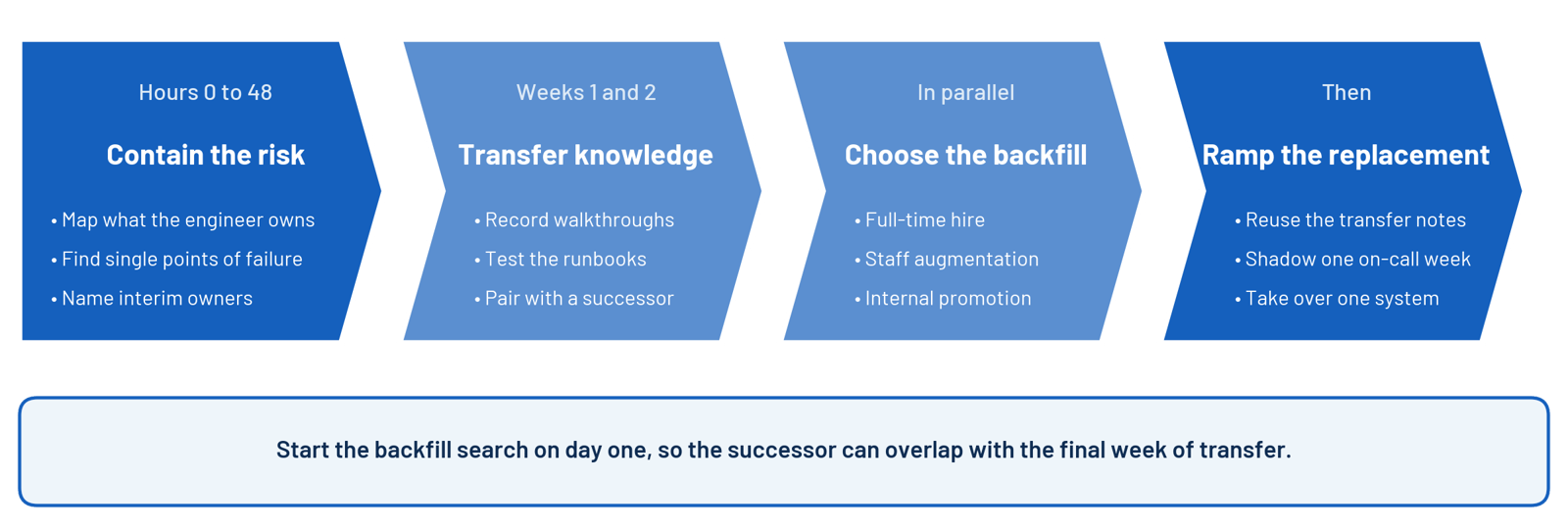
Start with facts, not reactions. Confirm the last working day and what the engineer owns. Then contain the risk.
Map ownership. List the services, repositories, on-call rotations, and vendor relationships the engineer owns.
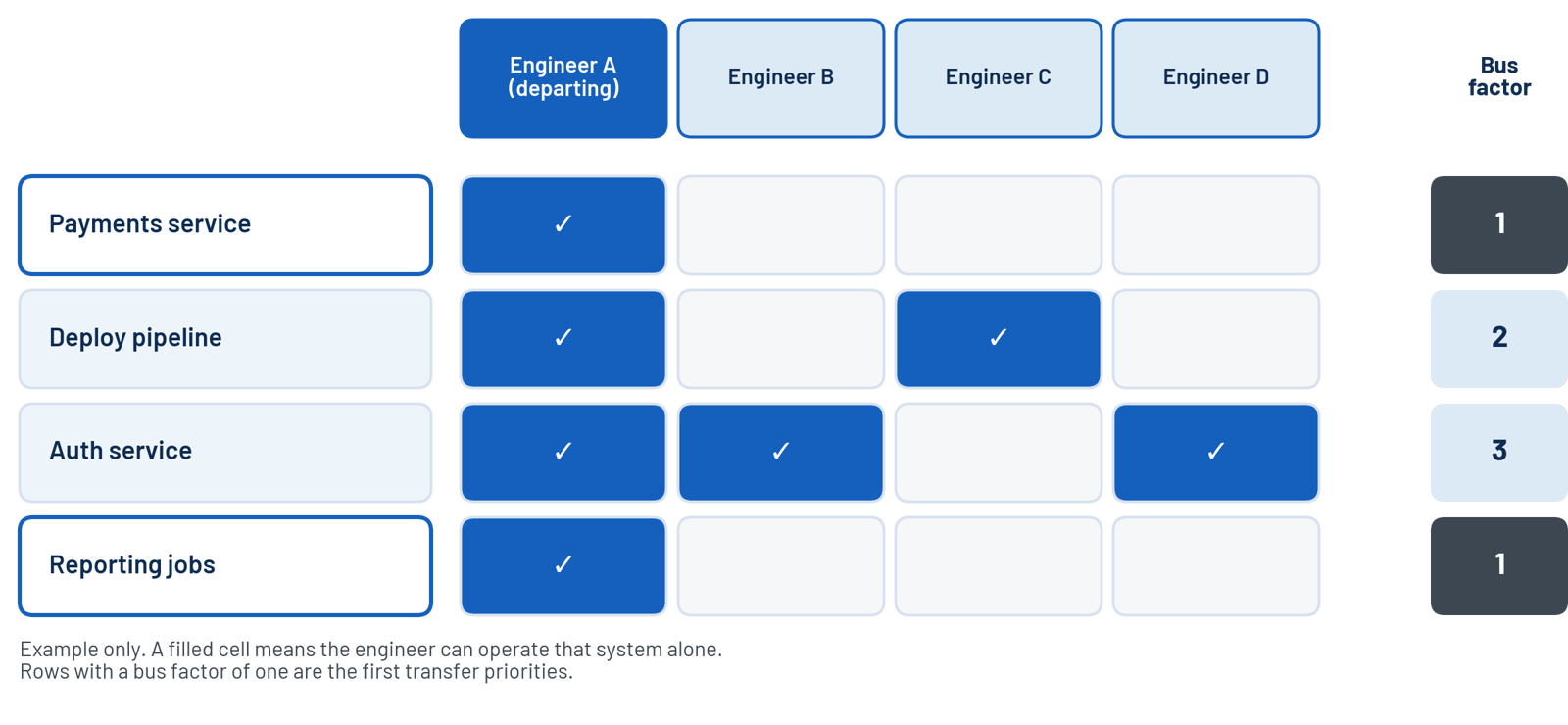
Find single points of failure. Mark every system only this person understands. Bus factor is the number of people who would need to leave before a project stalls, and a bus factor of one is the first risk to remove.
Pause nonessential scope. Move work that depends on the departing engineer's judgment out of the next sprint.
Name an interim owner for each critical system.
Brief the team. Share the timeline and the plan so people hear facts, not rumors.
A Two-Week Knowledge Transfer Plan
Two weeks is enough to capture what matters if you focus on decisions, not documentation volume. Engineering knowledge transfer works best when every item has a named recipient.
Match each type of knowledge to a capture method and a recipient.
| Knowledge type | How to capture it | Who receives it |
|---|---|---|
| Architecture and design reasons | Recorded walkthrough plus a short decision log | Interim owner and the incoming engineer |
| Operational runbooks | Written steps, tested by someone else | On-call engineers |
| In-flight work | Handoff notes on each open pull request and ticket | The engineer taking each item |
| Production incident history | Annotated list of past incidents and fixes | The whole team |
| External contacts and vendors | Contact list with context on open issues | Engineering manager |
Pair the departing engineer with a successor on real work during the final week. Watching someone else operate a system transfers more than a document does. Ask the successor to run the next deployment while the departing engineer observes.
Who Covers What During the Gap
A vacancy spreads quietly across the people nearest to it. Assign each responsibility to a named person for the length of the gap, and review the list weekly.
Use this table as a starting point and adjust it to your team.
| Responsibility | Who covers it | What to review weekly |
|---|---|---|
| On-call for owned services | Two engineers who shadowed the departing engineer | Pages received and time to resolve |
| Code review on owned services | Rotating reviewers from the transfer pairs | Review wait time |
| Architecture decisions | The interim owner, with a second senior as sounding board | Decisions logged in the decision log |
| Mentoring | The tech lead, plus augmented seniors if you add them | One-on-ones completed |
| Vendor and stakeholder contact | The engineering manager | Open escalations |
How to Backfill a Senior Engineer: Your Three Options
When you need to replace a senior engineer, you rarely have one right answer. Compare the options on speed, fit, and commitment.
The hiring market adds pressure. ManpowerGroup's 2025 Talent Shortage Survey found that 71% of US employers report difficulty filling roles, and the Bureau of Labor Statistics projects 15% growth in software developer employment from 2024 to 2034.
This comparison shows how each path affects speed and risk.
| Option | Speed to impact | Best when | Main risk |
|---|---|---|---|
| Full-time external hire | Slowest: recruiting, notice periods, and onboarding stack up | The role is permanent and central to your product | A long gap leaves the team stretched |
| Staff augmentation | Fast: Bluelight onboards engineers in 7 to 14 business days | You need senior capacity now, or the need may change | Needs an internal owner to direct the work |
| Internal promotion | Immediate, but it moves the gap | A strong internal candidate is ready for the scope | Opens a second vacancy lower in the team |
Many teams combine two options: promote internally for ownership and add augmented engineers to restore capacity. For the structural decision between permanent and flexible capacity, see staff augmentation vs full-time hiring.
Facing an open senior seat right now? Nearshore engineers from Bluelight can start in 7 to 14 business days, backed by a 2-week risk-free trial. Expand Your Team →
Rewrite the Role Before You Rehire
A resignation is a chance to ask whether the old role still fits. Copying the previous job description into a new posting repeats yesterday's structure.
- Review what the engineer actually spent time on over the last six months.
- Split the role if it combined architecture, on-call, and mentoring in a way that wore the person down.
- Decide the seniority the next person needs for the coming year, not the last one.
- Check whether part of the scope belongs on another team or in a tool.
Once the role is clear, write it down for candidates. The guide to writing a technical job description that attracts senior engineers covers the structure.
Protect Velocity While the Seat Is Empty
More people do not close a gap quickly. Fred Brooks argued in The Mythical Man-Month that adding people to a late project makes it later, because new people need time and attention from the engineers already there. Reduce load first.
- Cut scope for one or two sprints. Commit to less than your average velocity.
- Limit work in progress. Finish what is open before you start new items.
- Spread reviews. Do not let pull request review pile up on the one remaining senior engineer.
- Watch the delivery metrics. Rising change lead time or review wait time shows strain early, and DORA's four keys give you a standard set to track.
- Reset stakeholder expectations. Tell them the date capacity returns, and decline new commitments until then.
Ramp the Replacement Fast
A replacement who understands the system in week two beats one who needs two months. Use the transfer material you already built. Give the new engineer the recorded walkthroughs and the decision log, and have them shadow one on-call rotation. Assign a first task in a system the departing engineer owned, with the interim owner as reviewer.
Time zone overlap speeds up this ramp. In Bluelight's nearshore benchmark, nearshore engineers finished change requests 84% faster than an offshore team, and the gap came from same-day answers, which matter most when the code is new to you.
Mistakes to Avoid When You Backfill a Senior Engineer
- Rushing a hire to fill the title. A weak senior hire costs the team more than a longer search.
- Skipping the scope review. You inherit the old role's overload along with its title.
- Loading the remaining seniors. Burnout starts in the gap and spreads.
- Staying quiet about the departure. Teams fill silence with worse stories than the real one.
- Starting the transfer on the last day. Capture begins the day notice is given.
Reduce the Impact of the Next Departure
Every resignation exposes how much knowledge sits with one person. Use it to improve.
- Rotate ownership of critical systems on a fixed schedule.
- Require pairing on risky changes.
- Keep runbooks and decision logs current as part of your definition of done.
- Track bus factor for each critical system every quarter.
Frequently Asked Questions
How do you backfill a senior engineer?
Contain the risk in the first 48 hours, run a two-week knowledge transfer, and choose a backfill path: a full-time hire, staff augmentation, internal promotion, or a mix. Reduce sprint scope while the seat is empty.
What should you do first when a senior engineer resigns?
Confirm the last day, map what the engineer owns, and identify systems only they understand. Name an interim owner for each critical system and tell the team the plan.
How do you transfer knowledge in two weeks?
Focus on decisions, not volume. Record architecture walkthroughs, write and test runbooks, hand off every open pull request, and pair the departing engineer with a successor on real work in the final week.
Should you backfill with a contractor or a full-time hire?
Use staff augmentation when you need capacity quickly or when the long-term shape of the role is unclear. Hire full time when the role is permanent and central to your product. Many teams do both in sequence.
How do you keep velocity when a senior engineer leaves?
Commit to less for a sprint or two, limit work in progress, spread code reviews across the team, and watch lead time and review wait time. Adding people alone will not speed up the work.
Can staff augmentation replace a senior engineer?
It can restore senior capacity fast. Bluelight onboards vetted nearshore engineers in 7 to 14 business days, and they work in your time zone. Pair them with an internal owner for system context.
Key Takeaways
- Spend the first 48 hours mapping ownership and single points of failure, and name an interim owner for every critical system.
- A two-week knowledge transfer works when every item has a capture method and a named recipient.
- Compare backfill options on speed, fit, and commitment. Many teams combine an internal promotion with augmented capacity.
- Protect velocity by cutting scope and limiting work in progress, because adding people to a late project makes it later.
- Use the transfer material to ramp the replacement, and treat each departure as a chance to lower your bus factor.
More cost-effective than hiring in-house, with Nearshore Boost, our nearshore software development service, you can ensure your business stays competitive with an expanded team and a bigger global presence, you can be flexible as you respond to your customers’ needs.
Learn more about our services by booking a free consultation with us today!


